
Preparation of Carrageenan/Chitosan/Curcumin Hydrogel Films: Physicochemical Characterization and In Vitro Evaluation as a Promising Diabetic Wound Dressing
Article Sidebar
-
Carrageenan, Chitosan, Curcumin, Diabetic Wounds , Hydrogel Film
Abstract
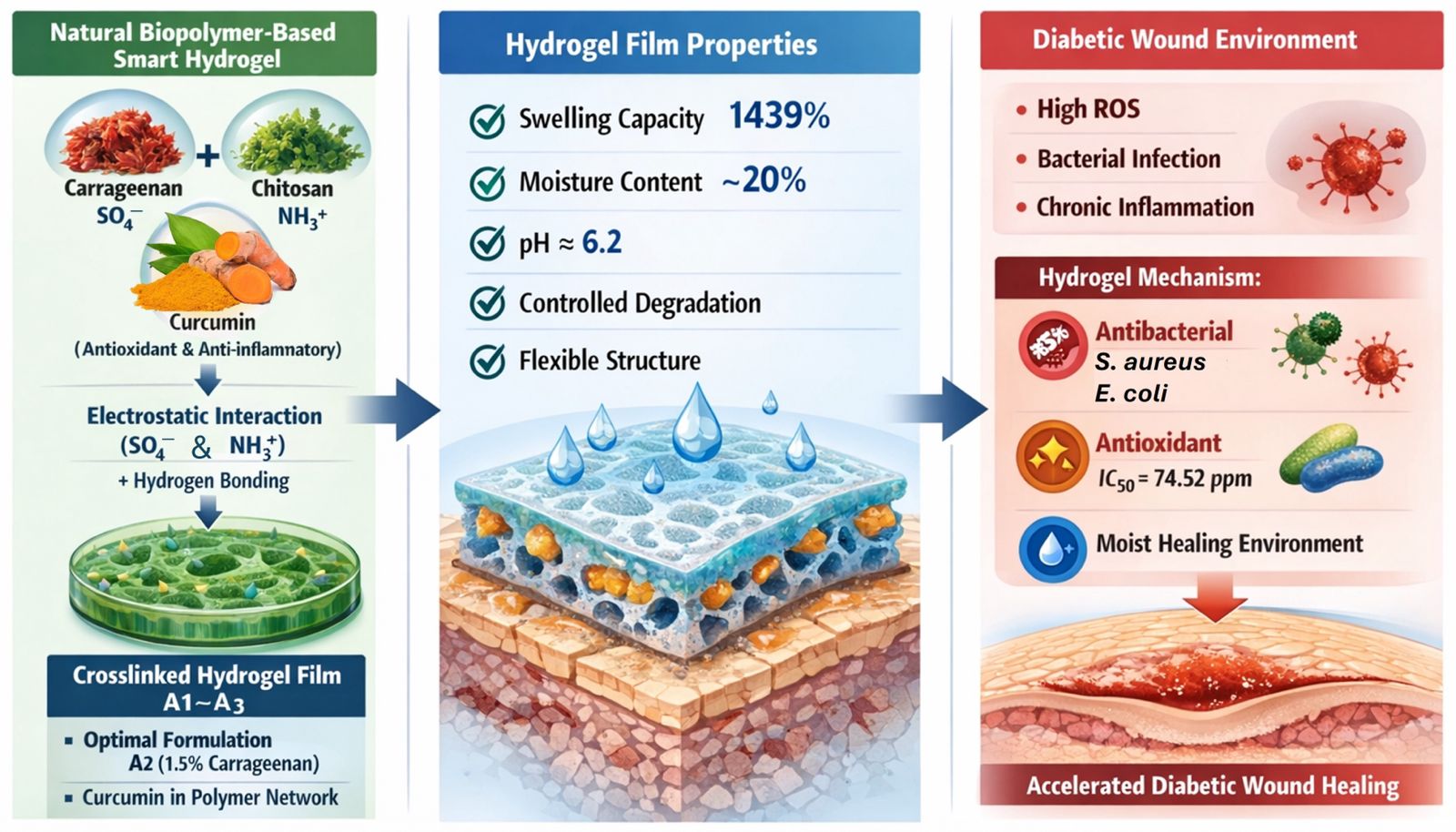
Wound dressings with their physical characteristics that can maintain moisture and their active content which possesses antibacterial and antioxidant properties, represent a crucial solution in addressing the delayed healing of diabetic wounds. For this purpose, in this work we prepared hydrogel films made from a combination of carrageenan, chitosan, and curcumin, and subsequently evaluated their performance for potential application as the diabetic wound dressings. There were three hydrogel film formulations fabricated using 0.5% chitosan, 0.05% curcumin, and carrageenan at varying concentrations of 1%, 1.5%, and 2%, which were subsequently designated as A1, A2, and A3, respectively. These films were examined for physical parameters, chemical profiles, antibacterial activity against Staphylococcus aureus and Escherichia coli, and antioxidant activity (DPPH assay). The A2 film formulation demonstrated optimal characteristics, as evidenced by a high swelling capacity of 1439.67 ± 20.36%, an appropriate moisture content of 20.63 ± 0.49%, a film pH of 6.23 ± 0.31%, favorable degradation behavior of 93.27 ± 1.36%, and a film thickness of 0.20 ± 0.001 mm. This formulation also demonstrated superior antibacterial activity against Staphylococcus aureus and Escherichia coli, accompanied by strong antioxidant activity (IC50 = 74.52 ppm). Such results indicate that the carrageenan/chitosan/curcumin hydrogel film, particularly formulation A2, is a promising smart hydrogel dressing candidate for diabetic wound applications.
References
Ali, S. M. A., J. Khan, R. Shahid, S. Shabbir, M. F. Ayoob, and M. Imran (2024). Chitosan-Carrageenan Microbeads Containing Nano-Encapsulated Curcumin: Nano-in-Micro Hydrogels as Alternative-Therapeutics for Resistant Pathogens AssociatedWith ChronicWounds. International Journal of Biological Macromolecules, 278; 134841
Amine, C., A. Boire, A. Kermarrec, and D. Renard (2019). Associative Properties of Rapeseed Napin and Pectin: Competition Between Liquid-Liquid and Liquid-Solid Phase Separation. Food Hydrocolloids, 92; 94–103
Aranaz, I., A. R. Alcántara, M. C. Civera, C. Arias, B. Elorza, A. Heras Caballero, and N. Acosta (2021). Chitosan: An Overview of Its Properties and Applications. Polymers, 13(19); 3256
Atgié, M., J. C. Garrigues, A. Chennevière, O. Masbernat, and K. Roger (2019). Gum Arabic in Solution: Composition andMulti-Scale Structures. FoodHydrocolloids, 91; 319–330
Boateng, J. S., K. H. Matthews, H. N. E. Stevens, and G. M. Eccleston (2008). Wound Healing Dressings and Drug Delivery Systems: A Review. Journal of Pharmaceutical Sciences, 97(8); 2892–2923
Brett, D. W. (2006). A Review of Moisture-Control Dressings in Wound Care. Journal of Wound, Ostomy & Continence Nursing, 33(Supplement 6S); S3–S8
Campo, V. L., D. F. Kawano, D. B. D. Silva, and I. Carvalho (2009). Carrageenans: Biological Properties, ChemicalModifications and Structural Analysis – A Review. Carbohydrate Polymers, 77(2); 167–180
Chen, A., S. Deng, J. Lai, J. Li, W. Chen, S. N. Varma, J. Zhang, C. Lei, C. Liu, and L. Huang (2023a). Hydrogels for Oral Tissue Engineering: Challenges and Opportunities. Molecules, 28(9); 3946
Chen, H., J. Cheng, L. Ran, K. Yu, B. Lu, G. Lan, F. Dai, and F. Lu (2018). An Injectable Self-Healing Hydrogel With Adhesive and Antibacterial Properties Effectively Promotes Wound Healing. Carbohydrate Polymers, 201; 522–531
Chen, Y., X. Wang, S. Tao, Q. Wang, P.-Q. Ma, Z.-B. Li, Y.-L. Wu, and D.-W. Li (2023b). Research Advances in Smart Responsive-Hydrogel DressingsWith Potential Clinical Diabetic Wound Healing Properties. Military Medical Research, 10(1); 37
Escárcega-Galaz, A. A., D. I. Sánchez-Machado, J. López-Cervantes, A. Sanches-Silva, T. J. Madera-Santana, and P. Paseiro-Losada (2018). Mechanical, Structural and Physical Aspects of Chitosan-Based Films as Antimicrobial Dressings. International Journal of BiologicalMacromolecules, 116; 472–481
Gao, D., Y. Zhang, D. T. Bowers,W. Liu, and M. Ma (2021). Functional Hydrogels for Diabetic Wound Management. APL Bioengineering, 5(3); 031503
Gerardi, D., S. Bernardi, A. Bruni, G. Falisi, and G. Botticelli (2024). Characterization and Morphological Methods for Oral Biofilm Visualization: Where AreWe Nowadays? AIMS Microbiology, 10(2); 391–414
Guo, S. and L. A. DiPietro (2010). Factors AffectingWound Healing. Journal of Dental Research, 89(3); 219–229
Han, C., R. K. Singla, and C.Wang (2025). Application of Biomaterials in DiabeticWound Healing: The Recent Advances and Pathological Aspects. Pharmaceutics, 17(10); 1295
He, X., Y.Wei, and K. Xu (2025). Hydrogel-Based Treatment of DiabeticWounds: From Smart Responsive to Smart Monitoring. Gels, 11(8); 647
Hidayaty, A. N., S. Fiddaroini, A. L. Fahmi, Q. Fardiyah, and A. Sabarudin (2026). Optimization and Stability Assessment of Chitosan/PVA Smart Sensor Films Incorporated With Roselle Anthocyanins for Real-Time Visual Monitoring of Chicken and Shrimp Freshness Under Different Storage Conditions. Science and Technology Indonesia, 11(1); 217–234
Hoare, T. R. and D. S. Kohane (2008). Hydrogels in Drug Delivery: Progress and Challenges. Polymer, 49(8); 1993–2007
Hossain, M. J., M. Al-Mamun, and M. R. Islam (2024). Diabetes Mellitus, the Fastest Growing Global Public Health Concern: Early Detection Should Be Focused. Health Science Reports, 7(3); e2004
Jin, X.,W. Lan,W. Yong, Z. Yuan, X. Li, and X. Cui (2026). Application and Development of Stimulus-Responsive Hydrogel Biomaterials for DiabeticWound Healing: A Literature Review. Frontiers in Medicine, 12; 1740559
Khodaei, T., J. Nourmohammadi, A. Ghaee, and Z. Khodaii (2023). An Antibacterial and Self-Healing Hydrogel From Aldehyde-Carrageenan for Wound Healing Applications. Carbohydrate Polymers, 302; 120371
Kong, M., X. G. Chen, K. Xing, and H. J. Park (2010). Antimicrobial Properties of Chitosan and Mode of Action: A State of the Art Review. International Journal of Food Microbiology, 144(1); 51–63
Li, G., Q. Xiao, L. Zhang, Y. Zhao, and Y. Yang (2017). Nerve Growth Factor Loaded Heparin/Chitosan Scaffolds for Accelerating Peripheral Nerve Regeneration. Carbohydrate Polymers, 171; 39–49
Liu, Z., Y. Lv, G. Zheng, W. Wu, and X. Che (2023). Chitosan/Polylactic Acid Nanofibers Containing Astragaloside IV as a New Biodegradable Wound Dressing for Wound Healing. AAPS PharmSciTech, 24(7); 202
Lupa, D.,W. Płaziński, A. Michna, M.Wasilewska, P. Pomastowski, A. Gołębiowski, B. Buszewski, and Z. Adamczyk (2022). Chitosan Characteristics in Electrolyte Solutions: CombinedMolecular DynamicsModeling and Slender Body Hydrodynamics. Carbohydrate Polymers, 292; 119676
Madaniyah, L., S. Fiddaroini, E. K. Hayati, M. F. Rahman, and A. Sabarudin (2025). Stability of Biologically Synthesized Silver Nanoparticles (AgNPs) Using Acalypha indica L. Plant Extract as Bioreductor and Their Potential as Anticancer Agents Against T47D Cells. Science and Technology Indonesia, 10(1); 101–110
Necas, J. and L. Bartosikova (2013). Carrageenan: A Review. Veterinární Medicína, 58(4); 187–205
Nešporová, K., V. Pavlík, B. Šafránková, H. Vágnerová, P. Odráška, O. Žídek, N. Císařová, S. Skoroplyas, L. Kubala, and V. Velebný (2020). Effects of Wound Dressings Containing Silver on Skin and Immune Cells. Scientific Reports, 10(1); 15216
Priyadarsini, K. (2014). The Chemistry of Curcumin: From Extraction to Therapeutic Agent. Molecules, 19(12); 20091–20112
Rabea, E. I., M. E.-T. Badawy, C. V. Stevens, G. Smagghe, andW. Steurbaut (2003). Chitosan as Antimicrobial Agent: Applications and Mode of Action. Biomacromolecules, 4(6); 1457–1465
Reig-Vano, B., B. Tylkowski, X. Montané, and M. Giamberini (2021). Alginate-Based Hydrogels for Cancer Therapy and Research. International Journal of Biological Macromolecules, 170; 424–436
Rinaudo, M. (2006). Chitin and Chitosan: Properties and Applications. Progress in Polymer Science, 31(7); 603–632
Rizky, A., D. Tanjung, and K. Khairunnisa (2024). The Effect of Ozone Therapy Stimulation on DiabetesWound Healing Process. Contagion: Scientific Periodical Journal of Public Health and Coastal Health, 6(1); 480
Rupert, R., K. F. Rodrigues, V. Y. Thien, and W. T. L. Yong (2022). Carrageenan From Kappaphycus alvarezii (Rhodophyta, Solieriaceae): Metabolism, Structure, Production, and Application. Frontiers in Plant Science, 13; 859635
Shah, S. A., M. Sohail, M. Karperien, C. Johnbosco, A. Mahmood, and M. Kousar (2023). Chitosan and Carboxymethyl Cellulose-Based 3D Multifunctional Bioactive Hydrogels Loaded With Nano-Curcumin for Synergistic Diabetic Wound Repair. International Journal of Biological Macromolecules, 227; 1203–1220
Sharma, S., J. Mohler, S. D. Mahajan, S. A. Schwartz, L. Bruggemann, and R. Aalinkeel (2023). Microbial Biofilm: A Review on Formation, Infection, Antibiotic Resistance, Control Measures, and Innovative Treatment. Microorganisms, 11(6); 1614
Sidhu, G. S., A. K. Singh, D. Thaloor, K. K. Banaudha, G. K. Patnaik, R. C. Srimal, and R. K. Maheshwari (1998). Enhancement of Wound Healing by Curcumin in Animals. Wound Repair and Regeneration, 6(2); 167–177
Song, Y., J. Y. Seo, H. Kim, S. Cho, and K.-Y. Baek (2022). Pore-Size Control of Chitin Nanofibrous Composite Membrane Using Metal-Organic Frameworks. Carbohydrate Polymers, 275; 118754
Sweeney, I. R., M. Miraftab, and G. Collyer (2012). A Critical Review ofModern and Emerging Absorbent Dressings Used to Treat ExudingWounds. InternationalWound Journal, 9(6); 601–612
Szliszka, E., Z. P. Czuba, M. Domino, B. Mazur, G. Zydowicz, and W. Krol (2009). Ethanolic Extract of Propolis (EEP) Enhances the Apoptosis-Inducing Potential of TRAIL in Cancer Cells. Molecules, 14(2); 738–754
Tashakkorian, H., V. Hasantabar, A. Mostafazadeh, and M. Golpour (2020). Transparent Chitosan Based Nanobiocomposite Hydrogel: Synthesis, Thermophysical Characterization, Cell Adhesion and Viability Assay. International Journal of Biological Macromolecules, 144; 715–724
Tian,W., L. Dai, S. Lu, Z. Luo, Z. Qiu, J. Li, P. Li, and B. Du (2019). Effect of Bacillus sp. DU-106 Fermentation on Dendrobium officinale Polysaccharide: Structure and Immunoregulatory Activities. International Journal of Biological Macromolecules, 135; 1034–1042
Vilchez, A., F. Acevedo, M. Cea, M. Seeger, and R. Navia (2021). Development and Thermochemical Characterization of an Antioxidant Material Based on Polyhydroxybutyrate Electrospun Microfibers. International Journal of Biological Macromolecules, 183; 772–780
Xie,W., X. Meng, Y. Zhai, P. Zhou, T. Ye, Z.Wang, G. Sun, and X. Sun (2018). Panax Notoginseng Saponins: A Review of Its Mechanisms of Antidepressant or Anxiolytic Effects andNetwork Analysis on Phytochemistry and Pharmacology. Molecules, 23(4); 940
Xing, J., P. Tao, Z.Wu, C. Xing, X. Liao, and S. Nie (2019). Nanocellulose-Graphene Composites: A Promising Nanomaterial for Flexible Supercapacitors. Carbohydrate Polymers, 207; 447–459
Yallapu, M. M., M. Jaggi, and S. C. Chauhan (2012). Curcumin Nanoformulations: A Future Nanomedicine for Cancer. Drug Discovery Today, 17(1–2); 71–80
Zhang, X., Y. Liu, Z.Wang, H. Zhao, L. Zhan, H. Gui, X. Xu, X. Ma, and B. Ma (2025). pH-Responsive and Self-Adaptive Injectable Sodium Alginate/Carboxymethyl Chitosan Hydrogel Accelerates InfectedWound Healing by Bacteriostasis and Immunomodulation. Carbohydrate Polymers, 354; 123322
Authors

This work is licensed under a Creative Commons Attribution 4.0 International License.