
Isolation on Unsaturated Fatty Acids from Erminalia catappa L. Seed Oil Using Urea Crystallization Method as A Basic Material for Dihydroxy Octadecanoic Acid
Article Sidebar
-
Dihydroxy Octadecanoic Acid, Unsaturated Fatty Acids, Urea Crystallization, Terminalia catappa Seed Oil
Abstract
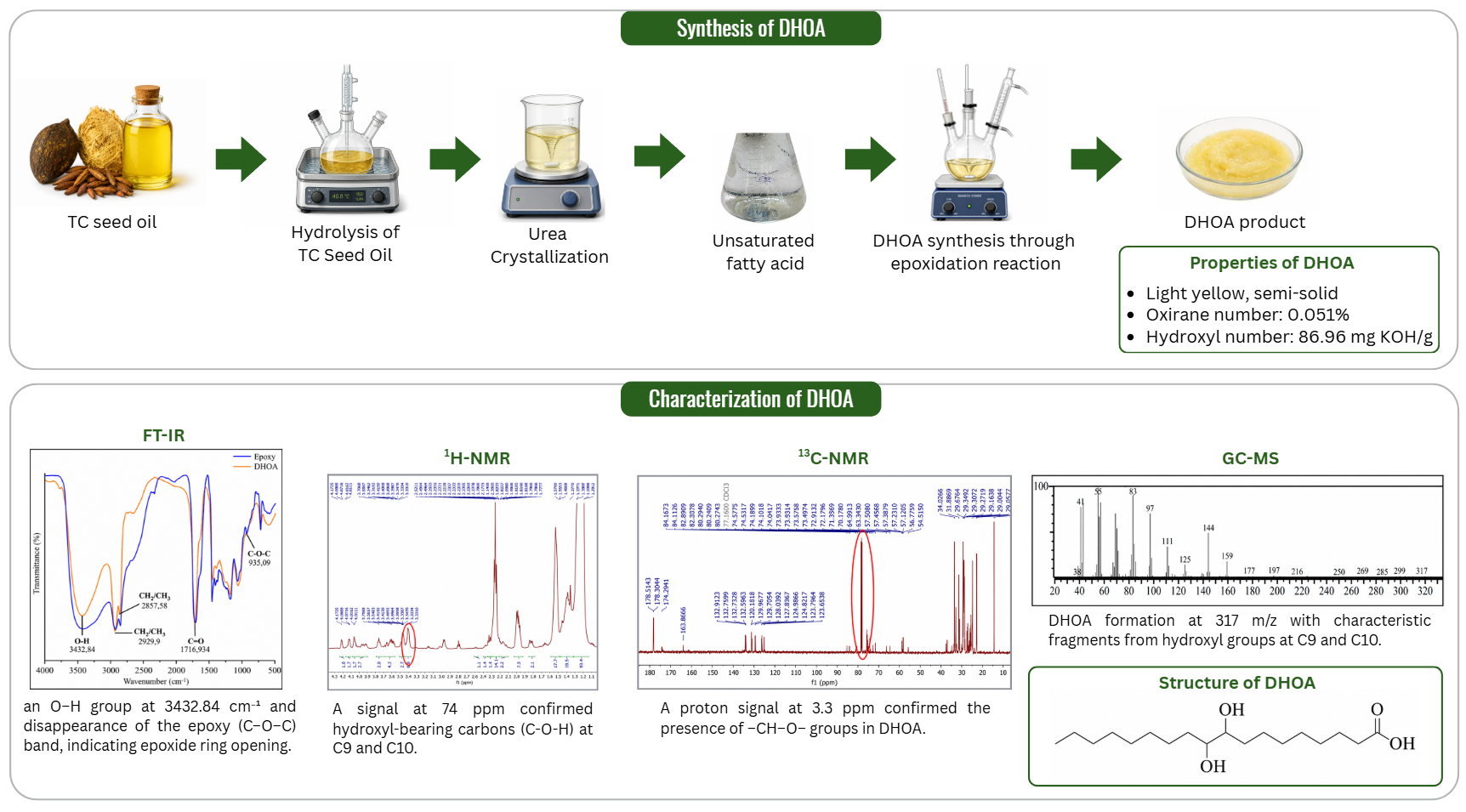
Dihydroxyoctadecanoic acid (DHOA) is a fatty acid-based compound with industrial and cosmetic applications. This compound can be synthesized through the chemical transformation of unsaturated fatty acids in vegetable oils, including Terminalia catappa L. (TC) seed oil. In this study, DHOA was synthesized and characterized using the unsaturated fatty acid (UFA) fraction of TC seed oil as the precursor. The UFA fraction was enriched by urea crystallization and subsequently subjected to epoxidation and hydroxylation reactions to convert the double bonds into dihydroxy groups through an epoxide intermediate. The UFA fraction was obtained as a viscous yellow liquid, with a maximum yield of 27.14% at a urea-to-fatty acid ratio of 8.57:1 (w/w). The fraction exhibited an iodine value of 74.23 mg I₂ g⁻¹ and a hydroxyl value of 33.66 mg KOH g⁻¹, indicating the presence of unsaturation and hydroxyl groups (−OH). GC-MS analysis showed that the urea crystallization product contained 73.28% unsaturated fatty acids. The resulting DHOA was obtained as a pale yellow semi-solid with an oxirane oxygen content (OOC) of 0.051% and a hydroxyl value of 186.96 mg KOH g⁻¹, indicating a low residual epoxide content and a high concentration of hydroxyl groups. Spectroscopic characterization revealed an O–H absorption band at 3432.84 cm⁻¹ in the FT-IR spectrum, accompanied by the disappearance of the epoxide C–O–C band. The ¹³C NMR spectrum exhibited a resonance at approximately δ 74 ppm, indicating hydroxylated carbon, while the ¹H NMR spectrum showed a resonance at approximately δ 3.3 ppm, corresponding to a methine proton in a –CH–O environment. Overall, these spectroscopic results provide structural evidence for the successful formation of DHOA.
References
Akoh, C. C. (2017). Food Lipids: Chemistry, Nutrition, and Biotechnology. CRC Press, Taylor & Francis.
Atabani, A. E., A. S. Silitonga, H. C. Ong, T. M. I. Mahlia, H. H. Masjuki, I. A. Badruddin, and H. Fayaz (2013). Non-Edible Vegetable Oils: A Critical Evaluation of Oil Extraction, Fatty Acid Compositions, Biodiesel Production, Characteristics, Engine Performance and Emissions Production. Renewable and Sustainable Energy Reviews, 18; 211–245.
Awang, R., S. Ahmad, Y. B. Kang, and R. Ismail (2001). Characterization of Dihydroxystearic Acid from Palm Oleic Acid. Journal of the American Oil Chemists’ Society, 78(12); 1249–1252.
Baena, A., A. Orjuela, S. K. Rakshit, and J. H. Clark (2022). Enzymatic Hydrolysis of Waste Fats, Oils and Greases (FOGs): Status, Prospective, and Process Intensification Alternatives. Chemical Engineering and Processing - Process Intensification, 175; 108930.
Boateng, L., R. Ansong, W. B. Owusu, and M. Steiner-Asiedu (2016). Coconut Oil and Palm Oil’s Role in Nutrition, Health and National Development: A Review. Ghana Medical Journal, 50(3); 189–196.
Cao, X., X. Wei, Y. Shao, D. Li, and J. Zhu (2025). Jatropha Curcas Seed Oil for Possible Human Consumption: A Toxicological Assessment of Its Phorbol Esters. Toxicology Reports, 14; 101870.
Chamidah, A. and A. Wicaksono (2021). Pembuatan Konsentrat Omega-3 Dari Minyak Hati Hiu Botol Dengan Metode Kristalisasi Urea. Jurnal Perikanan Universitas Gadjah Mada, 23(2); 119.
Christie, W. W. (2003). Lipid Analysis: Isolation, Separation, Identification and Structural Analysis of Lipids. The Oily Press, 3rd edition.
Cogliano, T., R. Turco, M. Di Serio, T. Salmi, R. Tesser, and V. Russo (2024). Epoxidation of Vegetable Oils via the Prilezhaev Reaction Method: A Review of the Transition from Batch to Continuous Processes. Industrial & Engineering Chemistry Research, 63(26); 11231–11262.
Crane, S., G. Aurore, H. Joseph, Z. Mouloungui, and P. Bourgeois (2005). Composition of Fatty Acids, Triacylglycerols and Unsaponifiable Matter in Calophyllum calaba L. Oil from Guadeloupe. Phytochemistry, 66(15); 1825–1831.
Derawi, D., J. Salimon, and W. Abdo Ahmed (2014). Preparation of Epoxidized Palm Olein as Renewable Material by Using Peroxy Acids. The Malaysian Journal of Analytical Sciences, 18(3); 584–591.
Engkvist, O., S. L. Price, and A. J. Stone (2000). Developments in Computational Studies of Crystallization and Morphology Applied to Urea. Physical Chemistry Chemical Physics, 2(13); 3017–3027.
Flores, M., C. Saravia, C. E. Vergara, F. Avila, H. Valdés, and J. Ortiz-Viedma (2019). Avocado Oil: Characteristics, Properties, and Applications. Molecules, 24(11).
Ghanbari, E., S. J. Picken, and J. H. van Esch (2023). Analysis of Differential Scanning Calorimetry (DSC): Determining the Transition Temperatures, and Enthalpy and Heat Capacity Changes in Multicomponent Systems by Analytical Model Fitting. Journal of Thermal Analysis and Calorimetry, 148(22); 12393–12409.
González-Fernández, M. J., D. Fabrikov, S. Lyashenko, F. Ferrón-Carrillo, and J. L. Guil-Guerrero (2020). Highly Concentrated Very Long-Chain PUFA Obtainment by Urea Complexation Methodology. Environmental Technology & Innovation, 18; 100736.
Gunawan, E. R. and D. Suhendra (2012). Screening dan Analisis Kadar Omega-3 dari Rumput Laut Pulau Lombok NTB. Jurnal Ilmiah Kimia, 7(2); 95–104.
Gunawan, E. R., D. Suhendra, P. Arimanda, D. Asnawati, and Murniati (2023). Epoxidation of Terminalia catappa L. Seed Oil: Optimization Reaction. South African Journal of Chemical Engineering, 43; 128–134.
Habri, H. H., A. S. A. Shahrizan, I. S. Azmi, N. Hambali, A. Shamjuddin, S. Salaeh, and M. J. Jalil (2024). Degradation Autocatalytic Epoxidation of Oleic Acid Derived from Palm Oil via in Situ Performic Acid Mechanism. Environmental Progress & Sustainable Energy, 43(6).
Hadi, A., M. J. Jalil, A. F. M. Yamin, and I. S. Azmi (2023). Single Step Synthesis of Dihydroxystearic Acid (DHSA) from Epoxidized Palm Oil. Journal of Polymers and the Environment, 31(2); 709–721.
Halaldeen, F., I. Zahir, S. Ulpathakumbura, L. Jayasinghe, N. Marikkar, M. M. Musthafa, M. Arshad, A. A. Al Kheraif, F. M. Husain, and M. Adil (2024). Characterization of Oils and Defatted Residues of Terminalia catappa L. Seed Kernels of Two Varieties. International Journal of Food Properties, 27(1); 30–43.
Hassabo, A. G., S. Sharaawy, and A. L. Mohamed (2018). Saturated Fatty Acids Derivatives as Assistants Materials for Textile Processes. Journal of Textile Science & Fashion Technology, 1(4).
Ismail, T. N. M. T., K. W. Lee, S. Adnan, Z. H. Ban, Z. A. A. Hasan, and P. Siwayanan (2024). Investigating the Potential of Dihydroxystearic Acid as Feedstock for Rigid Polyurethane Foam. Industrial Crops and Products, 209; 118067.
Jain, M., U. Chandrakant, V. Orsat, and V. Raghavan (2018). A Review on Assessment of Biodiesel Production Methodologies from Calophyllum inophyllum Seed Oil. Industrial Crops and Products, 114; 28–44.
Jalil, M. J., K. A. Kamal, A. F. B. M. Yamin, I. S. Azmi, M. H. Hassan, A. R. Hidayu, and K. N. Ismail (2021). High Yield Dihydroxystearic Acid (DHSA) Based on Kinetic Model from Epoxidized Palm Oil. Kemija u Industriji, 70(1–2); 23–28.
Japir, A. A.-W., J. Salimon, D. Derawi, B. H. Yahaya, M. Bahadi, S. Al-Shuja’a, and M. R. Yusop (2018). A Highly Efficient Separation and Physicochemical Characteristics of Saturated Fatty Acids from Crude Palm Oil Fatty Acids Mixture Using Methanol Crystallisation Method. OCL Oilseeds & Fats Crops and Lipids, 25(2); A203.
Jumaah, M. A., M. Firdaus, M. Yusoff, J. Salimon, and M. Bahadi (2019). Separation of Saturated and Unsaturated Fatty Acids of Palm Fatty Acid Distilled via Low-Temperature Methanol Crystallization. Malaysian Journal of Chemistry, 2(21); 8–16.
Kusumaningtyas, R. D., H. Prasetiawan, N. D. Anggraeni, E. D. N. Anisa, and D. Hartanto (2022). Conversion of Free Fatty Acid in Calophyllum inophyllum Oil to Fatty Acid Ester as Precursor of Bio-Based Epoxy Plasticizer via SnCl2-Catalyzed Esterification. Polymers, 15(1).
Lee, J., K. Lee, S. Lee, I. Kim, and C. Rhee (2004). Selective Increase in Pinolenic Acid (all-cis-5,9,12-18:3) in Korean Pine Nut Oil by Crystallization and Its Effect on LDL-Receptor Activity. Lipids, 39(4); 383–387.
Lee, T., Z. Spankulova, U. Orazbayeva, S. Didorenko, and S. Atabayeva (2016). Polyunsaturated Fatty Acids Content in Soybean Oil. Advance Journal of Food Science and Technology, 12(10); 568–573.
Liu, J. and B. Tao (2022). Fractionation of Fatty Acid Methyl Esters via Urea Inclusion and Its Application to Improve the Low-Temperature Performance of Biodiesel. Biofuel Research Journal, 9(2); 1617–1629.
Mahadi, M. B., I. M. Rasib, N. Z. Abas, M. A. Rahman, I. SH Azmi, and M. J. Jalil (2022). Selective Epoxidation of the Unsaturated Fatty Acids. IOP Conference Series: Materials Science and Engineering, 1257(1); 012017.
Maisaroh, M., I. B. Susetyo, and B. Rusmandana (2016). Synthesis of 9,10-Dihydroxy Stearic Acid (DHSA) Through Epoxide Hydrolysis from the Oxidation of Oleic Acid with Performic Acid. REAKTOR, 16(2); 57–64.
Mancini, A., E. Imperlini, E. Nigro, C. Montagnese, A. Daniele, S. Orrù, and P. Buono (2015). Biological and Nutritional Properties of Palm Oil and Palmitic Acid: Effects on Health. Molecules, 20(9); 17339–17361.
Marín-Suárez, M., D. Méndez-Mateos, A. Guadix, and E. M. Guadix (2019). Reuse of Immobilized Lipases in the Transesterification of Waste Fish Oil for the Production of Biodiesel. Renewable Energy, 140; 1–8.
Maruyama, H., K. Fukuchi, and H. Seki (2022). Modeling of Separation of Fatty Acid Methyl Esters Derived from Fisheries Waste by Urea Complexation Method. Biochemical Engineering Journal, 188; 108689.
McLafferty, F. W. and F. Tureček (1993). Interpretation of Mass Spectra. University Science Books, 4th edition.
Menkiti, M. C., C. M. Agu, and T. K. Udeigwe (2015). Extraction of Oil from Terminalia catappa L.: Process Parameter Impacts, Kinetics, and Thermodynamics. Industrial Crops and Products, 77; 713–723.
Mohamed, N., M. J. Jalil, S. K. Jamaludin, A. Rafizan, and M. Daud (2014). Formation of Dihydroxystearic Acid from Hydrolysis of Palm Kernel Oil Based Epoxidized Oleic Acid. Journal of Applied Science and Agriculture, 9(11); 86–92.
Ng, J. S., S. A. Muhammad, B. Ibrahim, M. Rafatullah, I. Strashnov, C. H. Yong, S. Hossain, N. H. H. Abu Bakar, S. D. Kelly, A. Cannavan, and O. Ogundipe (2025). Fatty Acid Diagnostic Ratios to Screen for Used Oil Adulteration in Refined, Bleached, Deodorised Palm Oil. Food Analytical Methods, 18(8); 1685–1698.
Ohlan, R., B. Narasimhan, S. Ohlan, R. Narang, and V. Judge (2008). Synthesis and Antimicrobial Evaluation of Urea Inclusion Complexes. Organic Communications, 1(2); 24–32.
Orhevba, B. A., S. E. Adebayo, and A. O. Salihu (2016). Synthesis of Biodiesel from Tropical Almond (Terminalia catappa) Seed Oil. Current Research in Agricultural Sciences, 3(4); 57–63.
Rasib, I. M., M. J. Jalil, N. M. Mubarak, and I. S. Azmi (2025). Hybrid In-Situ and Ex-Situ Hydrolysis of Catalytic Epoxidation Neem Oil via a Peracid Mechanism. Scientific Reports, 15(1); 147.
Rastegari, H., S. Espootin, H. S. Ghaziaskar, N. I. Yatim, and N. Ali (2022). Fractionation of Fish Waste Oil through Low Temperature Crystallization in Acetone Followed by Urea Complexation. Journal of Biopolymers and Theoretical Studies, 2(1); 71–78.
Revelou, P.-K., M. Xagoraris, A. Alexandropoulou, C. D. Kanakis, G. K. Papadopoulos, C. S. Pappas, and P. A. Taran tilis (2021). Chemometric Study of Fatty Acid Composition of Virgin Olive Oil from Four Widespread Greek Cultivars. Molecules, 26(14); 4151.
Roslan, A., M. J. Jalil, I. S. Azmi, N. S. Aznizam, S. A. Mustapha, A. N. Masri, N. M. Mubarak, and A. Hosseini Bandegharaei (2025). In Situ Epoxidation of Hybrid Waste Cooking Oil and Oleic Acid via Peracid Mechanism. Scientific Reports, 15(1); 19304.
Setyawardhani, D. A., I. F. Ihsani, S. A. D. Lestari, H. R. Zhafirah, V. Silvia, Fadilah, and Y. C. Danarto (2024). Crystallization Temperature and Solvent Composition Effect for Enhancement of Unsaturated Fatty Acids from Palm Oil Using Urea Complexation. Jurnal Teknologi (Sciences & Engineering), 87(1); 89–97.
Setyawardhani, D. A., M. Margono, A. Pratama, and F. Petratama (2018). The Concentration of Polyunsaturated Fatty Acid in Palm Oil by Urea Complexation. Equilibrium Journal of Chemical Engineering, 2(1); 25.
Setyawardhani, D. A., H. Sulistyo, W. B. Sediawan, and M. Fahrurrozi (2015). Separating Poly-Unsaturated Fatty Acids from Vegetable Oil Using Urea Complexation: The Crystallisation Temperature Effects. Journal of Engineering Science and Technology; 41–49.
Silalahi, M. (2022). Ketapang (Terminalia catappa L.): Potential Utilization as Foodstuffs and Traditional Medicine. Open Access Research Journal of Life Sciences, 3(2); 035–041.
Silitonga, A. S., H. H. Masjuki, T. M. I. Mahlia, H. C. Ong, A. E. Atabani, and W. T. Chong (2013). A Global Comparative Review of Biodiesel Production from Jatropha curcas Using Different Homogeneous Acid and Alkaline Catalysts: Study of Physical and Chemical Properties. Renewable and Sustainable Energy Reviews, 24; 514–533.
Silva, T. d. A., W. J. Keijok, M. C. C. Guimarães, S. T. A. Cassini, and J. P. de Oliveira (2022). Impact of Immobilization Strategies on the Activity and Recyclability of Lipases in Nanomagnetic Supports. Scientific Reports, 12(1); 6815.
Silvianti, F., W. Wijayanti, W. A. A. Sudjarwo, and W. B. Dewi (2018). Synthesis of Alkyd Resin Modified with Waste Palm Cooking Oil as Precursor Using Pretreatment with Zeolite Adsorbent. Science and Technology Indonesia, 3(3); 119–122.
Suhendra, D., E. Ryantin Gunawan, E. Yuanita, and M. Nazili (2018). Optimization of Lipase-Catalyzed Synthesis of Fatty Hydroxamic Acids from Terminalia catappa L. Kernel Oil. Oriental Journal of Chemistry, 34(5); 2370–2377.
Yong, Q., G. Yuan, and H. Li (2021). Extraction and Separation of Unsaturated Fatty Acids from Sunflower Oil. IOP Conference Series: Earth and Environmental Science, 680(1); 012063.
Authors

This work is licensed under a Creative Commons Attribution 4.0 International License.