
Synthesis and Characterization of Superabsorbent Bio-Based Hydrogels from Pandanus tectorius Leaf Cellulose through Ester-Based Crosslinking for Water-Holding Applications
Article Sidebar
-
Carboxymethyl Cellulose (CMC), Hydrogels, Hydroxyethyl Cellulose (HEC), SDG 6 (Clean Water and Sanitation)
Abstract
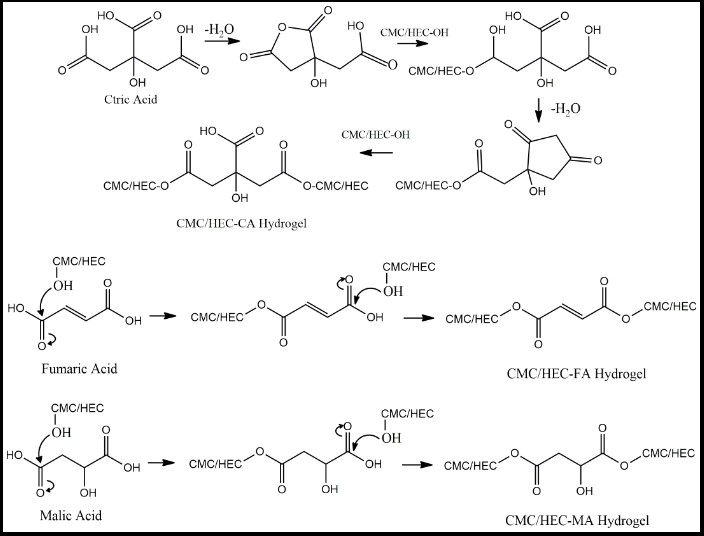
The development of sustainable hydrogels from renewable biomass has attracted increasing interest for environmental and agricultural applications. In this study, cellulose isolated from Pandanus tectorius leaves was utilized as a precursor for the synthesis of carboxymethyl cellulose (CMC), which was subsequently used to prepare hydrogels through ester-based crosslinking. A dual-network hydrogel structure was formed by blending CMC with hydroxyethyl cellulose (HEC), followed by esterification with citric (CA), fumaric (FA), and malic (MA) acids. Structural characterization using FTIR confirmed successful carboxymethylation and ester crosslinking within the polymer network, while SEM revealed a porous morphology favorable for water diffusion. The synthesized hydrogels exhibited gel fractions of 67–89%, swelling ratios of 578–4163%, and maximum degradation temperatures of 311–428°C. The CMC/HEC-MA hydrogel at a 15% crosslinker concentration demonstrated the most balanced combination of swelling capacity, gel fraction, and thermal stability. Owing to their high water-retention capability, porous structure, and biodegradability, these hydrogels show strong potential as superabsorbent materials for soil moisture conservation, controlled water release in agriculture, drought mitigation, and sustainable water management. These findings highlight the potential of biomass-derived hydrogels to support SDG 2 (Zero Hunger) by improving agricultural water retention, SDG 6 (Clean Water and Sanitation) by promoting efficient water management and treatment, and SDG 12 (Responsible Consumption and Production) by transforming renewable biomass resources into sustainable value-added materials.
References
Agbna, G. H. and S. J. Zaidi (2025). Hydrogel Performance in Boosting Plant Resilience to Water Stress—A Review. Gels, 11(4); 276.
Agustina, S., S. Fiddaroini, A. L. Fahmi, E. D. Iftitah, M. F. Rahman, A. Sabarudin, et al. (2026). Preparation of Carrageenan/Chitosan/Curcumin Hydrogel Films: Physicochemical Characterization and in Vitro Evaluation As a Promising Diabetic Wound Dressing. Science and Technology Indonesia, 11(3); 994–1015.
Ahmed, E. M. (2015). Hydrogel: Preparation, Characterization, and Applications: A Review. Journal of Advanced Research, 6(2); 105–121.
Ali, K., Z. Asad, G. H. Agbna, A. Saud, A. Khan, and S. J. Zaidi (2024). Progress and Innovations in Hydrogels for Sustainable Agriculture. Agronomy, 14(12); 2815.
Altaf, F., M. B. K. Niazi, Z. Jahan, T. Ahmad, M. A. Akram, A. Safdar, M. S. Butt, T. Noor, and F. Sher (2021). Synthesis and Characterization of PVA/Starch Hydrogel Membranes Incorporating Essential Oils Aimed to Be Used in Wound Dressing Applications. Journal of Polymers and the Environment, 29(1); 156–174.
Asl, S. A., M. Mousavi, and M. Labbafi (2017). Synthesis and Characterization of Carboxymethyl Cellulose from Sugarcane Bagasse. J. Food Process. Technol., 8(8); 687.
Bashir, S., M. Hina, J. Iqbal, A. Rajpar, M. Mujtaba, N. Alghamdi, S. Wageh, K. Ramesh, and S. Ramesh (2020). Fundamental Concepts of Hydrogels: Synthesis, Properties, and Their Applications. Polymers, 12(11); 2702.
Chang, C. and L. Zhang (2011). Cellulose-Based Hydrogels: Present Status and Application Prospects. Carbohydrate Polymers, 84(1); 40–53.
de Lima, G. F., A. G. de Souza, and D. d. S. Rosa (2020). Nanocellulose As Reinforcement in Carboxymethylcellulose Superabsorbent Nanocomposite Hydrogels. In Macromolecular Symposia, volume 394. Wiley Online Library, page 2000126.
Demitri, C., R. Del Sole, F. Scalera, A. Sannino, G. Vasapollo, A. Maffezzoli, L. Ambrosio, and L. Nicolais (2008). Novel Superabsorbent Cellulose-Based Hydrogels Crosslinked with Citric Acid. Journal of Applied Polymer Science, 110(4); 2453–2460.
Dolbow, J., E. Fried, and H. Ji (2005). A Numerical Strategy for Investigating the Kinetic Response of Stimulus-Responsive Hydrogels. Computer Methods in Applied Mechanics and Engineering, 194(42–44); 4447–4480.
Durpekova, S., K. Filatova, J. Cisar, A. Ronzova, E. Kutalkova, and V. Sedlarik (2020). A Novel Hydrogel Based on Renewable Materials for Agricultural Application. International Journal of Polymer Science, 2020(1); 8363418.
Feng, W. and Z. Wang (2023). Tailoring the Swelling-Shrinkable Behavior of Hydrogels for Biomedical Applications. Advanced Science, 10(28); 2303326.
Franklin, D. and S. Guhanathan (2014). Synthesis and Characterization of Citric Acid-Based pH-Sensitive Biopolymeric Hydrogels. Polymer Bulletin, 71(1); 93–110.
Hashem, M., S. Sharaf, M. Abd El-Hady, and A. Hebeish (2013). Synthesis and Characterization of Novel Carboxymethylcellulose Hydrogels and Carboxymethylcellulose-Hydrogel-ZnO Nanocomposites. Carbohydrate Polymers, 95(1); 421–427.
Huang, C. M., P. X. Chia, C. S. Lim, J. Q. Nai, D. Y. Ding, P. B. Seow, C. W. Wong, and E. W. Chan (2017). Synthesis and Characterisation of Carboxymethyl Cellulose from Various Agricultural Wastes. Cellulose Chemistry and Technology, 51(7–8); 665–672.
Jiang, X. and L. Zhou (2025). Progress, Challenge and Perspective of Hydrogels Application in Food: A Review. npj Science of Food, 9(1); 155.
Kabir, S. F., P. P. Sikdar, B. Haque, M. R. Bhuiyan, A. Ali, and M. Islam (2018). Cellulose-Based Hydrogel Materials: Chemistry, Properties and Their Prospective Applications. Progress in Biomaterials, 7(3); 153–174.
Kim, H. S. and S. W. Kang (2026). Hydroxyethyl Cellulose-Enhanced Hair Protectant: Improved Thermal Stability, Surface Morphology, and Moisturizing Performance. Macromolecular Research, 34(5); 643–654.
Kowalski, G., P. Ptaszek, and Ł. Kuterasiński (2020). Swelling of Hydrogels Based on Carboxymethylated Starch and Poly (Acrylic Acid): Nonlinear Rheological Approach. Polymers, 12(11); 2564.
Li, X. and J. P. Gong (2024). Design Principles for Strong and Tough Hydrogels. Nature Reviews Materials, 9(6); 380–398.
MohanKumar, B., G. Priyanka, S. Rajalakshmi, R. Sankar, T. Sabreen, and J. Ravindran (2022). Hydrogels: Potential Aid in Tissue Engineering—A Review. Polymer Bulletin, 79(9); 7009–7039.
Morán, J. I., V. A. Alvarez, V. P. Cyras, and A. Vázquez (2008). Extraction of Cellulose and Preparation of Nanocellulose from Sisal Fibers. Cellulose, 15(1); 149–159.
Nasution, H., H. Harahap, N. F. Dalimunthe, M. H. S. Ginting, M. Jaafar, O. O. Tan, H. K. Aruan, and A. L. Herfananda (2022). Hydrogel and Effects of Crosslinking Agent on Cellulose-Based Hydrogels: A Review. Gels, 8(9); 568.
Neethu, T., P. Dubey, and A. Kaswala (2018). Prospects and Applications of Hydrogel Technology in Agriculture. Int. J. Curr. Microbiol. Appl. Sci., 7(5); 3155–3162.
Noviza, D., S. P. Ardelia, et al. (2026). Design and Formulation of Hydrogel Sponges for Mesenchymal Stem Cell Secretome Delivery. Science and Technology Indonesia, 11(2); 692–700.
Nurhaliza, Y., F. Nurulhaq, S. Yudhanto, and V. Suryanti (2022). Edible Film from Microcrystalline Cellulose (MMC) of Waste Banana (Musa paradisiaca) Stem and Chitosan. In Journal of Physics: Conference Series, volume 2190. IOP Publishing, page 012027.
Priya, A. S., R. Premanand, I. Ragupathi, V. R. Bhaviripudi, R. Aepuru, K. Kannan, and K. Shanmugaraj (2024). Comprehensive Review of Hydrogel Synthesis, Characterization, and Emerging Applications. Journal of Composites Science, 8(11); 457.
Priya, G., U. Narendrakumar, and I. Manjubala (2019). Thermal Behavior of Carboxymethyl Cellulose in the Presence of Polycarboxylic Acid Crosslinkers: G. Priya et al. Journal of Thermal Analysis and Calorimetry, 138(1); 89–95.
Qiu, Y. X., Q. R. Wanyan, W. T. Zhang, S. Yin, et al. (2021). Functional Biopolyesters Based on Cross-Linked Poly(L-Malic Acid): Network Engineering Towards Tailoring Brittle-Ductile Transition and Shape-Memory Performance. Polymer, 221; 123628.
Reddy, N., R. Reddy, and Q. Jiang (2015). Crosslinking Biopolymers for Biomedical Applications. Trends in Biotechnology, 33(6); 362–369.
Salama, S. Z., M. Firdaus, and V. Suryanti (2024). Cellulose Ethers from Banana (Musa balbisiana Colla) Blossom Cellulose: Synthesis and Multivariate Optimization. Indonesian Journal of Chemistry, 24(1); 200–212.
Salama, S. Z., V. Suryanti, M. Firdaus, and S. Narendraduhita (2026). Green Metrics Evaluation of a Sustainable Ultrasonication-Assisted Routes to Cellulose Ethers from Banana (Musa balbisiana Colla) Blossom Cellulose. Journal of Multidisciplinary Applied Natural Science, 6(3); 1291–1306.
Saputra, A. H., M. Hapsari, A. B. Pitaloka, and P. Wulan (2015). Synthesis and Characterization of Hydrogel from Cellulose Derivatives of Water Hyacinth (Eichhornia crassipes) through Chemical Cross-Linking Method by Using Citric Acid. J. Eng. Sci. Technol., 10; 75–86.
Segneanu, A.-E., L. E. Bejenaru, C. Bejenaru, A. Blendea, G. D. Mogoşanu, A. Biţă, and E. R. Boia (2025). Advancements in Hydrogels: A Comprehensive Review of Natural and Synthetic Innovations for Biomedical Applications. Polymers, 17(15); 2026.
Seki, Y., A. Altinisik, B. Demircioğlu, and C. Tetik (2014). Carboxymethylcellulose (CMC)–Hydroxyethylcellulose (HEC)-Based Hydrogels: Synthesis and Characterization. Cellulose, 21(3); 1689–1698.
Shariatinia, Z. and A. M. Jalali (2018). Chitosan-Based Hydrogels: Preparation, Properties and Applications. International Journal of Biological Macromolecules, 115; 194–220.
Shen, H., J. Sun, Z. Zhang, X. Zhang, W. Yan, R. Yao, H. Du, Y. Geng, G. Zhou, Y. Xu, et al. (2026). A Covalently Micro-Crosslinked Anionic Copolymer-Based Microgel for High-Temperature and Salt-Tolerant Water-Based Drilling Fluids. Gels, 12(7); 588.
Son, K. H. and J. W. Lee (2016). Synthesis and Characterization of Poly (Ethylene Glycol)-Based Thermo-Responsive Hydrogels for Cell Sheet Engineering. Materials, 9(10); 854.
Suryanti, V., T. Kusumaningsih, D. Safriyani, and I. S. Cahyani (2023). Synthesis and Characterization of Cellulose Ethers from Screw Pine (Pandanus tectorius) Leaves Cellulose As Food Additives. International Journal of Technology, 14(3); 659–668.
Trisnawati, E. W., I. S. Cahyani, D. Safriyani, E. Pramono, and V. Suryanti (2023a). Cellulose, Cellulose Benzoate and Cellulose Citrate from Screw Pine (Pandanus tectorius) Leaves as PVDF Filler for Improved Permeability and Anti-Fouling Properties. Periodica Polytechnica Chemical Engineering, 67(3); 504–515.
Trisnawati, E. W., V. Suryanti, and E. Pramono (2024). Fabrication and Evaluation of PVDF Membranes Modified with Cellulose and Cellulose Esters from Peanut (Arachis hypogaea L.) Shell for Application in Methylene Blue Filtration. JCIS Open, 16; 100123.
Trisnawati, E. W., V. Suryanti, E. Pramono, I. S. Cahyani, and D. Safriyani (2023b). Synthesis of Cellulose Acetate from Screw Pine (Pandanus tectorius) Leaves for Enhancing Water Permeability and Fouling Resistance of PVDF Membrane. Indonesian Journal of Chemistry, 23(5); 1436–1444.
Tufan, M., E. Uraz, C. Tosun, and H. Gercel (2016). Synthesis and Characterization of Carboxymethyl Cellulose Film from Pistachio Shells. International Journal of Advances in Science, Engineering and Technology, 4(1); 153–155.
Winarti, C., M. Kurniati, I. Puspita, R. Suwarda, Widaningrum, and A. Maddu (2026). Synthesis and Characterization of Hydrogel Cassava Pulp–Poly (Acrylate–Acrylamide) at Various Concentrations of Acrylic Acid and Crosslinker. Science and Technology Indonesia, 11(1); 356–365.
Wulandari, W. T., A. Rochliadi, and I. M. Arcana (2016). Nanocellulose Prepared by Acid Hydrolysis of Isolated Cellulose from Sugarcane Bagasse. IOP Conference Series: Materials Science and Engineering, 107(1); 012045.
Yang, D. (2022). Recent Advances in Hydrogels. Chemistry of Materials, 34(5); 1987–1989.
Zhang, X., X. Kan, Y. Xie, Y. Wang, Z. Li, X. Lun, Y. Zhao, S. Zhang, N. Wu, and W. Xu (2025). Hydrogels Enabled Smart Agriculture: Preparation, Properties, Applications, and Future Prospects. Industrial Crops and Products, 235; 121804.
Authors

This work is licensed under a Creative Commons Attribution 4.0 International License.