
Equatorial Electrodynamic Disturbances During the May and October 2024 Extreme Geomagnetic Storms: Implications for HF Communication and Geomagnetically Induced Current Risks in Indonesia
Article Sidebar
-
Geomagnetic Storms, Prompt Penetration Electric Fields (PPEF), Geomagnetically Induced Currents (GICs), Ionospheric Storms, Equatorial Electrodynamics
Abstract
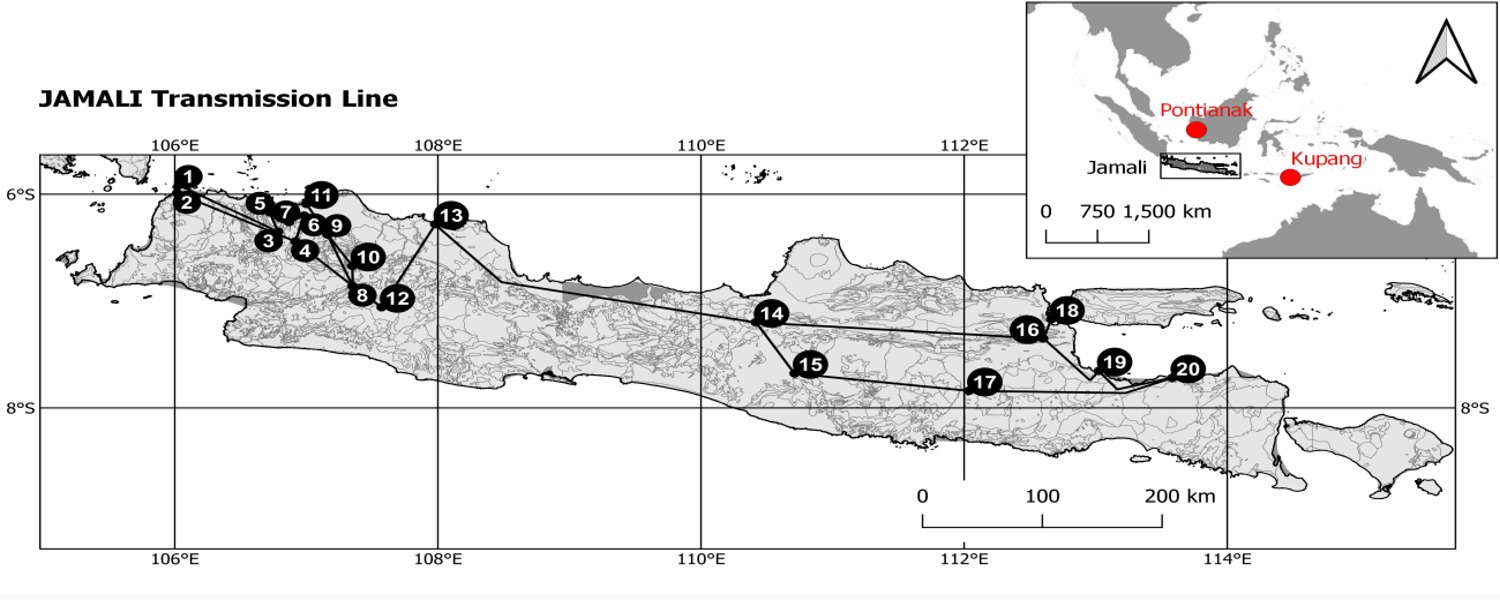
The effects of the two biggest storms of Solar Cycle 25, the intense geomagnetic storms of May 10–11 and October 10–11, 2024, on the Indonesian equatorial region are examined in this study. For the 500-kV Jawa-Madura-Bali (JAMALI) transmission network, geomagnetically induced current (GIC) modeling was integrated with magnetometer and ionosonde observations from Pontianak (PTN), close to the geomagnetic equator, and Kupang (KPG), close to the southern crest of the Equatorial Ionization Anomaly (EIA). During both storms, significant equatorial amplification was noted. While the October storm caused lower local perturbations, the horizontal magnetic disturbance at PTN during the May event reached -471 nT, around 16% bigger than the minimum global Dst index (-406 nT). In the JAMALI network, rapid changes in the geomagnetic field produced geoelectric fields that caused quasi-DC currents of 0.6–1.6 A. Such currents may contribute to long-term transformer stress even when they are below essential operational criteria. Significant ionospheric disruptions were caused by both storms, with foF2 reductions of more than 50% and matching drops in maximum usable frequency (MUF) of about 4 MHz, suggesting increased dangers to HF communication equipment. Ionospheric variability over Indonesia is regulated by geomagnetic latitude, local time, storm-time electrodynamic forcing, and thermospheric dynamics, as demonstrated by the differences between PTN and KPG responses.
References
Aa, E., Y. Chen, and B. Luo (2024). Dynamic Expansion and Merging of the Equatorial Ionization Anomaly During the 10–11 May 2024 Super Geomagnetic Storm. Remote Sensing, 16(22); 1–16.
Abadi, P., Y. Otsuka, H. X. Liu, K. Hozumi, D. R. Martinigrum, P. Jamjareegulgarn, L. T. Thanh, and R. Otadoy (2021). Roles of Thermospheric Neutral Wind and Equatorial Electrojet in Pre-Reversal Enhancement, Deduced from Observations in Southeast Asia. Earth and Planetary Physics, 5(5); 387–396.
Abda, Z. M. K., N. F. Ab Aziz, Z. A. Rhazali, and M. Z. A. Ab Kadir (2022). Geomagnetically Induced Current Analysis in Malaysian Power Transmission System. IEEE Access, 10; 110205–110216.
Ahmad, N., L. O. M. M. Kilowasid, H. Fakhrurroja, Neflia, A. Rachman, A. Husin, and H. Fathoni (2025). How Geomagnetic Storms Affect the Loss of Starlink Satellites in February 2022? Earth, Planets and Space, 77(1); 2.
Astafyeva, E., B. Maletckii, M. Förster, I. Ouar, J. Huba, M. Hairston, and W. Coley (2025). Electrodynamic and Ionospheric Puzzles of the 10–11 May 2024 Geomagnetic Superstorm. Journal of Geophysical Research: Space Physics, 130(5); e2024JA033284.
Balan, N., L. B. Liu, and H. J. Le (2018). A Brief Review of Equatorial Ionization Anomaly and Ionospheric Irregularities. Earth and Planetary Physics, 2(4); 257–275.
Barbosa, C., L. Alves, R. Caraballo, G. A. Hartmann, A. R. Papa, and R. J. Pirjola (2015). Analysis of Geomagnetically Induced Currents at a Low-Latitude Region Over the Solar Cycles 23 and 24: Comparison between Measurements and Calculations. Journal of Space Weather and Space Climate, 5; A35.
Bhattacharjee, S., M. N. Shrivastava, U. Pandey, B. Brawar, K. Nanda, S. K. Panda, S. M. Potirakis, S. Sasmal, A. Datta, and A. K. Maurya (2025). Contrasting Low-Latitude Ionospheric Total Electron Content Responses to the 7–8 and 10–11 October 2024 Geomagnetic Storms. Atmosphere, 16(12); 1–20.
Boteler, D. (2014). Methodology for Simulation of Geomagnetically Induced Currents in Power Systems. Journal of Space Weather and Space Climate, 4; A21.
Boteler, D. H. (2015). The Evolution of Québec Earth Models Used to Model Geomagnetically Induced Currents. IEEE Transactions on Power Delivery, 30(5); 2171–2178.
Breber, S. H. and K. A. Hadi (2024). The Impact of Geomagnetic Storms on the Ionospheric Critical Frequency in the Northern and Southern Mid-Latitude Hemisphere Regions. Iraqi Journal of Science, 65(10); 5999–6013.
Carmo, C. d. S. d., L. Dai, C. M. Wrasse, D. Barros, H. Takahashi, C. A. O. B. Figueiredo, C. Wang, H. Li, and Z. Liu (2024). Ionospheric Response to the Extreme 2024 Mother’s Day Geomagnetic Storm Over the Latin American Sector. Space Weather, 22(12); e2024SW004054.
Fejer, B. G., L. A. Navarro, and D. Chakrabarty (2024). Recent Results and Outstanding Questions on the Response of the Electrodynamics of the Low Latitude Ionosphere to Solar Wind and Magnetospheric Disturbances. Frontiers in Astronomy and Space Sciences, 11; 1471140.
Gonzalez-Esparza, J. A., E. Sanchez-Garcia, M. Sergeeva, P. Corona-Romero, L. X. Gonzalez-Mendez, J. F. Valdes-Galicia, et al. (2024). The Mother’s Day Geomagnetic Storm on 10 May 2024: Aurora Observations and Low-Latitude Space Weather Effects in Mexico. Space Weather, 22; e2024SW004111.
Guo, X., B. Zhao, T. Yu, H. Hao, W. Sun, G. Wang, M. He, T. Mao, G. Li, and Z. Ren (2024). East–West Difference in the Ionospheric Response During the Recovery Phase of May 2024 Super Geomagnetic Storm Over East Asia. Journal of Geophysical Research: Space Physics, 129(9); 1–20.
Horaites, K., M. Alho, Y. Pfau-Kempf, U. Ganse, A. Workayehu, J. Suni, et al. (2026). Geoelectric Field Caused by Flux Transfer Events in an Ionosphere-Coupled Vlasiator Simulation. Journal of Geophysical Research: Space Physics, 131; e2026JA035175.
Huang, C. S., S. Sazykin, J. L. Chau, N. Maruyama, and M. C. Kelley (2007). Penetration Electric Fields: Efficiency and Characteristic Time Scale. Journal of Atmospheric and Solar-Terrestrial Physics, 69(10–11); 1135–1146.
Huang, C. S. and Y. Zhang (2021). Equatorial Plasma Drifts During the Magnetic Storm on November 7–11, 2004: Identifications of the Roles of Penetration and Disturbance Dynamo Electric Fields With Multi-Instrumental Measurements. Journal of Geophysical Research: Space Physics, 126(9); 1–25.
Huang, F., J. Lei, X. Yue, Z. Li, N. Zhang, Y. Cai, et al. (2025). Interplay of Gravity Waves and Disturbance Electric Fields to the Abnormal Ionospheric Variations During the 11 May 2024 Superstorm. AGU Advances, 6; e2024AV001379.
International Electrotechnical Commission (2003). International Standard 60228. Technical Report 60228.
Ippolito, A., L. Perrone, C. Plainaki, and C. Cesaroni (2020). Investigating the foF2 Variations at the Ionospheric Observatory of Rome during Different Solar Cycles Minimums and Levels of Geomagnetic Activity. Journal of Space Weather and Space Climate, 10; 52.
Joshi, D. R., K. M. Groves, J. M. Retterer, C. S. Carrano, and P. A. Roddy (2022). Peak-Height Distribution of Equatorial Ionospheric Plasma Bubbles: Analysis and Modeling of C/NOFS Satellite Observations. Journal of Geophysical Research: Space Physics, 127(9); 1–17.
Kappenman, J. and W. Radasky (2021). Geomagnetic Field Impacts on Ground Systems. Space Weather Effects and Applications; 183–213.
Laundal, K. M. and A. D. Richmond (2017). Magnetic Coordinate Systems. Space Science Reviews, 206(1); 27–59.
Liu, C., Y. Li, and R. Pirjola (2014). Observations and Modeling of GIC in the Chinese Large-Scale High-Voltage Power Networks. Journal of Space Weather and Space Climate, 4; A03.
Loewe, C. A. and G. W. Prölss (1997). Classification and Mean Behavior of Magnetic Storms. Journal of Geophysical Research, 102(A7); 14209–14213.
Love, J. J., H. Hayakawa, and E. W. Cliver (2019). Intensity and Impact of the New York Railroad Superstorm of May 1921. Space Weather, 17(8); 1281–1292.
Marshall, R. A., H. Gorniak, T. Van Der Walt, C. L. Waters, M. D. Sciffer, M. Miller, M. Dalzell, T. Daly, G. Pouferis, G. Hesse, and P. Wilkinson (2013). Observations of Geomagnetically Induced Currents in the Australian Power Network. Space Weather, 11(1); 6–16.
Moges, S. T., N. M. Giday, D. A. Chekole, T. Ulich, and R. O. Sherstyukov (2022). Storm-Time Observations of Traveling Ionospheric Disturbances and Ionospheric Irregularities in East Africa. Radio Science, 57; e2022RS007426.
Nayak, C., S. Buchert, E. Yiğit, M. Ankita, S. Singh, S. Tulasi Ram, and A. P. Dimri (2025). Topside Low-Latitude Ionospheric Response to the 10–11 May 2024 Super Geomagnetic Storm as Observed by Swarm: The Strongest Storm-Time Super-Fountain During the Swarm Era? Journal of Geophysical Research: Space Physics, 130(3); e2024JA033340.
Paul, K. S., M. Moses, H. Haralambous, and C. Oikonomou (2025). Effects of the Mother’s Day Superstorm (10–11 May 2024) over the Global Ionosphere. Remote Sensing, 17(5); 1–24.
Rout, D., A. Kumar, R. Singh, S. Patra, D. K. Karan, S. Chakraborty, et al. (2025). Evidence of Unusually Strong Equatorial Ionization Anomaly at Three Local Time Sectors During the Mother’s Day Geomagnetic Storm on 10–11 May 2024. Geophysical Research Letters, 52; e2024GL111269.
Santoso, A., S. Sismanto, R. Priyatikanto, E. Hartantyo, E. S. Mumpuni, L. O. M. M. Kilowasid, A. Rachman, F. Nuraeni, S. Filawati, Erlansyah, and D. Nurmali (2025). Assessment of the Severe Geomagnetic Storm on May 10–11, 2024 Effects on the Geomagnetic Field and Ionosphere over the Indonesian Region. Rudarsko-Geološko-Naftni Zbornik, 40(4); 125–136.
Shreedevi, P., A. S. Nair, Y. Miyoshi, S. C. Buchert, Y. Otsuka, A. Shinbori, L. G. Krishnan, S. Perwitasari, and M. Nishioka (2025). Superstorm-Driven Electron Temperature (Te) Anomalies in the Topside Low-Latitude Ionosphere: Role of the Equatorial Ionization Anomaly (EIA). Earth, Planets and Space, 77(1); 163.
Silva, G. B. D. d., L. R. Alves, K. Espinosa, V. Souza, L. da Silva, J. Costa, M. Pádua, and S. Sanchez (2024). Evaluation of dB/dt Amplitudes and Sources Over the Brazilian Region during Geomagnetic Storms in the 2021–2022 Biennium. Journal of Atmospheric and Solar-Terrestrial Physics, 258; 106196.
Tulasi Ram, S., B. Veenadhari, A. Dimri, J. Bulusu, M. Bagiya, S. Gurubaran, N. Parihar, B. Remya, G. Seemala, R. Singh, et al. (2024). Super-Intense Geomagnetic Storm on 10–11 May 2024: Possible Mechanisms and Impacts. Space Weather, 22(12); e2024SW004126.
Vishnupriya, K. S. and G. Manju (2025). Risk Assessment of Geomagnetically Induced Currents (GICs) over the Indian Sector in Comparison with American and African Sectors. Space Weather, 23; e2024SW004133.
Watari, S., S. Nakamura, and Y. Ebihara (2021). Measurement of Geomagnetically Induced Current (GIC) Around Tokyo, Japan. Earth, Planets and Space, 73(1); 102.
Zawawi, A. A., N. F. A. Aziz, M. Z. A. A. Kadir, H. Hashim, and Z. Mohammed (2020). Evaluation of Geomagnetic Induced Current on 275 kV Power Transformer for a Reliable and Sustainable Power System Operation in Malaysia. Sustainability, 12(21); 1–23.
Zhang, X., W. Kong, N. Yu, H. Chen, T. Li, and E. Wang (2024). Comparison of Different Geoelectric Field Methods to Calculate Geomagnetically Induced Currents in North China. International Journal of Electrical Power & Energy Systems, 155; 109657.
Authors

This work is licensed under a Creative Commons Attribution 4.0 International License.