
Durability Controlled Hydration Mechanisms of High-Volume FABA-Based Binders with Nano Silica and Silica Fume Modification
Article Sidebar
-
Fly Ash-Bottom Ash (FABA), Mechanical Activation, Supplementary Cementitious Materials, Hydration, Low-Carbon Cementitious Binders
Abstract
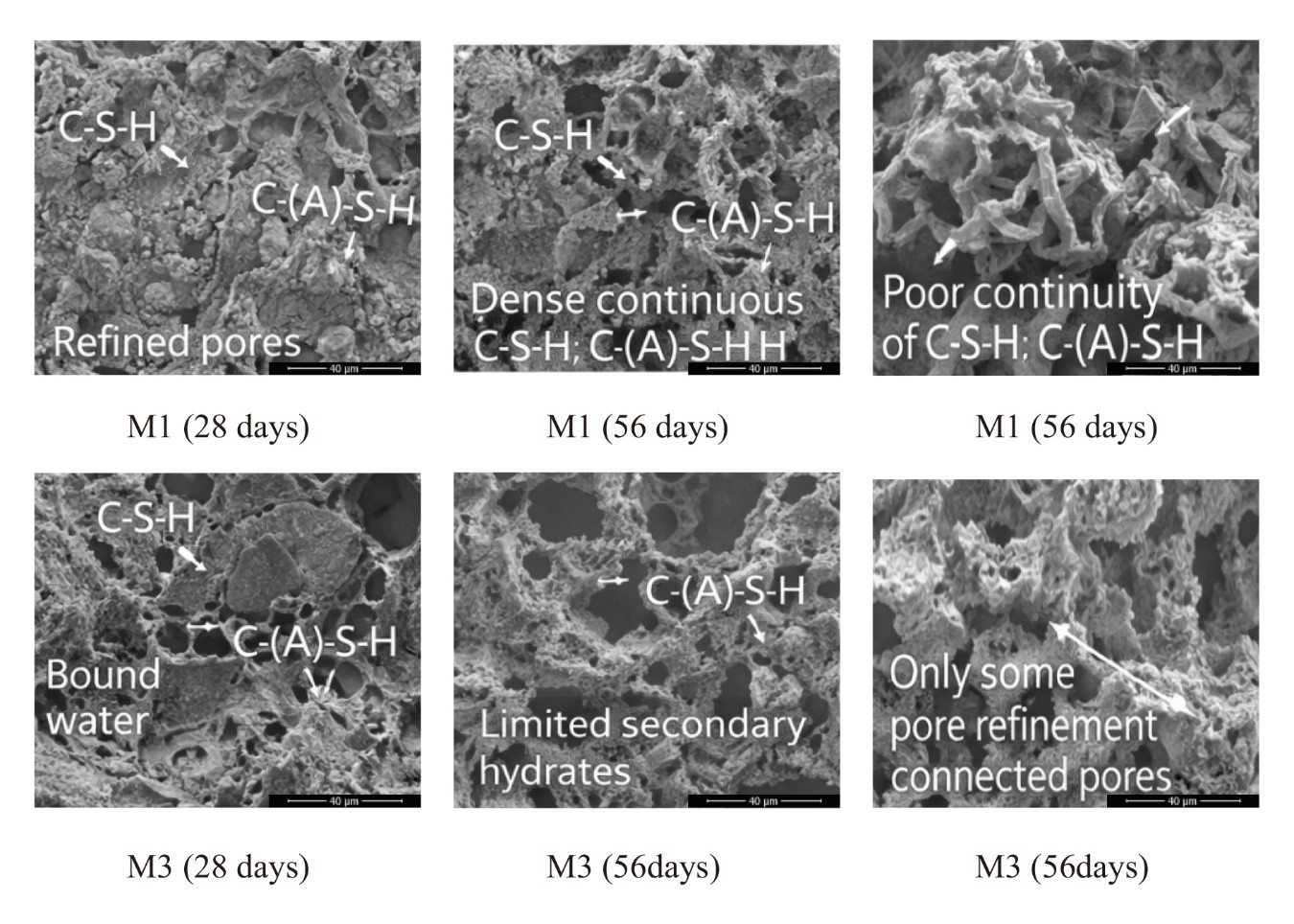
High-volume supplementary cementitious materials (SCMs) offer significant potential for reducing clinker consumption and CO2 emissions, but maintaining hydration efficiency and long-term durability remains a major challenge. This study investigated the hydration behavior, microstructural evolution, and transport-related durability of high-volume fly ash–bottom ash (FABA) binders incorporating mechanically activated bottom ash, nano-silica, and silica fume. The binder systems were evaluated using mechanical, transport, and integrated microstructural characterization. The 60% FABA (M1) binder exhibited the optimum performance, achieving a compressive strength of 44.5 MPa at 56 days together with the lowest sorptivity and water absorption. Integrated SEM, XRD, TGA/DTG, and BET/BJH analyses confirmed enhanced secondary hydration, progressive matrix densification, and mesopore refinement, with the highest specific surface area (11.9 m2/g) and the smallest average pore diameter (12.6 nm). These findings demonstrate that the durability of high-volume FABA binders is governed primarily by hydration-induced pore refinement and reduced pore connectivity, providing a scientific basis for the design of durable low-carbon cementitious binders with high clinker replacement.
References
ASTM International (2020). ASTM C1585-20: Standard Test Method for Measurement of Rate of Absorption of Water by Hydraulic-Cement Concretes. Standard, West Conshohocken, PA
ASTM International (2022). ASTM C642-21: Standard Test Method for Density, Absorption, and Voids in Hardened Concrete. Standard,West Conshohocken, PA
Bhandari, I., R. Kumar, A. Sofi, and N. S. Nighot (2023). A Systematic Study on Sustainable Low Carbon Cement–Superplasticizer Interaction: Fresh, Mechanical, Microstructural and Durability Characteristics. Heliyon, 9(9); e19176
Choi, Y.-C. (2025). The Effect of Colloidal Nano-Silica on the Initial Hydration of High-Volume Fly Ash Cement. Materials, 18(12); 2769
Cui, L., S. Chen, B. Liao, D. Chen, Z. Lv, S. Zhang, M. Guo, H. Rong, and T. Xiang (2025). Silica Fume Modified Superhydrophobic Cement-Based Materials with Enhanced Anti-Corrosion Property and Its Mechanism. Construction and Building Materials, 489; 142405
Deng, G., N. Zhang,W. Liao, H. Ma, Y. He, L. Lu, and L. Chi (2024). Pozzolanic Reactivity of Carbonated High-Calcium Fly Ash: A Mechanism Study. Construction and Building Materials, 446; 138015
Global Cement and Concrete Association (2021). GCCA 2050 Cement and Concrete Industry Roadmap for Net Zero Concrete. Global Cement and Concrete Association, London
Gómez-Pérez, J. F., D. L. Rugeles, J. S. Arango Arroyave, H. A. Agudelo, A. Sapi, and Z. Kónya (2025). Mechanical and Environmental Assessment of Mortars with High Coal-Bottom Ash Replacement from Local Industry. Construction and Building Materials, 482; 141696
Ho, L. S. and T. P. Huynh (2023). Long-Term Mechanical Properties and Durability of High-Strength Concrete Containing High-Volume Local Fly Ash as a Partial Cement Substitution. Results in Engineering, 18; 101113
Kalinkin, A. M., E. V. Kalinkina, E. A. Kruglyak, and A. G. Ivanova (2025). Alkali-Activated Binders from Copper–Nickel Slag and Fly Ash: A Synergistic Effect. Minerals, 15(12); 1297
Kang, H., J. Yang, S. Kim, A. Lim, and J. Moon (2024). Mechanochemical Activation for Transforming Bottom Ash to Reactive Supplementary Cementitious Material. Construction and Building Materials, 411; 134523
Kim, B.-J., G.-W. Lee, and Y.-C. Choi (2022). Hydration and Mechanical Properties of High-Volume Fly Ash Concrete with Nano-Silica and Silica Fume. Materials, 15(19); 6599
Kumar, M., A. K. Sinha, and J. Kujur (2021). Mechanical and Durability Studies on High-Volume Fly-Ash Concrete. Structural Concrete, 22; E1036–E1049
Li,W.,W. Liu, B.Wang, X. Zhan, J. Zuo, Y. Shan, S. Han, and T.Wang (2025). Synergistic Effects of Cement–Silica Fume Composite on Expansive Soil Stabilization: Mechanisms, Microstructure, and Durability. Results in Engineering, 28; 107811
Li, X. and K. L. Scrivener (2025). Quantification of Nano-Crystalline C S H in Hydrated Tricalcium Silicate, Portland Cement and Fly Ash Cement Using PONKCS Method. Cement and Concrete Research, 191; 107837
Mousa, A. (2023). Utilization of Coal Bottom Ash from Thermal Power Plants as a Cement Replacement for Building: A Promising Sustainable Practice. Journal of Building Engineering, 74; 106885
Oyejobi, D. O., A. A. Firoozi, D. B. Fernández, and S. Avudaiappan (2024). Integrating Circular Economy Principles into Concrete Technology: Enhancing Sustainability Through IndustrialWaste Utilization. Results in Engineering, 24; 102846
Pormmoon, P., P. Khongpermgoson Sanit-in, C. Jaturapitakkul, C. C. Ban, andW. Tangchirapat (2024). Strength, Durability, and Heat Development Characteristics of High-Performance Concrete Containing Ground Coal Bottom Ash with Low and High Calcium. Case Studies in Construction Materials, 21; e03845
Pramudiyanto, S. A. Kristiawan, S. Sangadji, and E. Safitri (2025). Sorptivity Characteristics of High-Volume Fly-Ash Self-Compacting Concrete with Various Fly-Ash Contents. IOP Conference Series: Earth and Environmental Science, 1564(1); 012060
Ribeiro, F. R. C., A. S. Ruviaro, P. R. de Matos, and A. P. Kirchheim (2025). Impact of Different Superplasticizers on Hydration, Rheology, Mechanical Strength, and Environmental Evaluation of LC3 Cements. Case Studies in Construction Materials, 23; e05347
Schackow, A., J. d. S. Andrade Neto, L. Hack, M. V. Folgueras, A. P. Kirchheim, E. D. Rodríguez Martinez, and P. R. de Matos (2025). Coal Bottom Ash as Supplementary Cementitious Material: Optimizing Reactivity Through Particle Grinding. Sustainability, 17(11); 5031
Scrivener, K. L., V. M. John, and E. M. Gartner (2018). Eco-Efficient Cements: Potential Economically Viable Solutions for a Low-CO2 Cement-Based Materials Industry. Cement and Concrete Research, 114; 2–26
Snehal, K., B. B. Das, and S. Barbhuiya (2023). Synergistic Effect of Nano Silica on Carbonation Resistance of Multi-Blended Cementitious Mortar. Cement and Concrete Composites, 141; 105125
Tao, C. and M. Massoudi (2024). On the Flow of a Cement Suspension: The Effects ofNano-Silica and Fly Ash Particles. Materials, 17(7); 1504
Tibbetts, C. M., J. M. Paris, C. C. Ferraro, K. A. Riding, and T. G. Townsend (2020). Relating Water Permeability to Electrical Resistivity and Chloride Penetrability of Concrete Containing Different Supplementary Cementitious Materials. Cement and Concrete Composites, 107; 103491
Tosti, L., A. van Zomeren, J. R. Pels, A. Damgaard, and R. N. J. Comans (2020). Life Cycle Assessment of the Reuse of Fly Ash from Biomass Combustion as Secondary Cementitious Material in Cement Products. Journal of Cleaner Production, 245; 118937
Wang, J., M. Liu, Y. Wang, Z. Zhou, D. Xu, P. Du, and X. Cheng (2020). Synergistic Effects of Nano-Silica and Fly Ash on Properties of Cement-Based Composites. Construction and Building Materials, 262; 120737
Authors

This work is licensed under a Creative Commons Attribution 4.0 International License.