
PVA/PVP Dissolving Microneedle Arrays Loaded with Parameria laevigata Extract: Formulation and Characterization for Transdermal Anti-Acne Therapy
Article Sidebar
-
Parameria laevigata, Dissolving Microneedle, PVA/PVP Matrix, Transdermal Delivery, Anti-Acne Therapy
Abstract
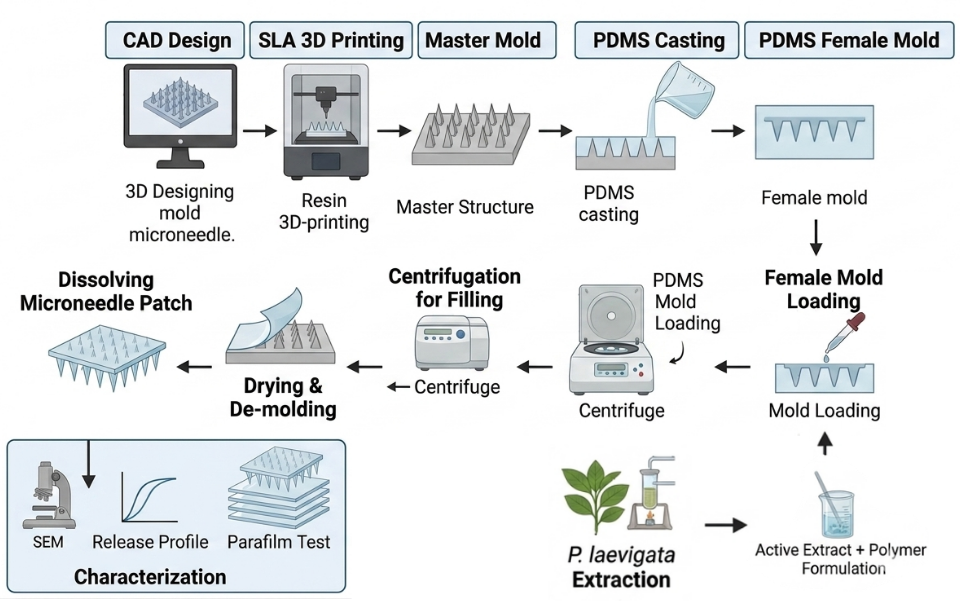
Despite the well-documented antimicrobial and antioxidant properties of Parameria laevigata (kayu rapet) bark, its incorporation into a dissolving microneedle (DMN) platform for transdermal acne therapy has not been previously investigated. This study developed and characterized PVA/PVP-based DMN arrays loaded with P. laevigata extract as a minimally invasive delivery system targeting acne-associated pathogens. Ultrasonic-assisted extraction in 95% ethanol yielded a phytochemical-rich extract (8.68%) containing flavonoids, tannins, saponins, and alkaloids, with strong antioxidant activity (DPPH IC50 = 40.98 ± 4.32 ppm; ABTS IC50 = 46.92 ± 3.25 ppm; FRAP = 70.24 ± 6.41 mg AAE/g extract) and moderate antibacterial activity against Acne vulgaris-associated bacteria Staphylococcus aureus and Cutibacterium acnes at 100–150 ppm (inhibition zone: 8.22–8.46 mm). Eight DMN formulations were fabricated at a fixed 30% w/w PVA/PVP total polymer concentration with 5% extract loading. The optimized formulation (F2) produced a complete 49-needle pyramidal array with adequate mechanical integrity for stratum corneum penetration, confirmed polymer–extract physicochemical compatibility by FTIR, and exhibited Korsmeyer–Peppas release kinetics with a diffusion-controlled mechanism reaching 56.48% cumulative release over 24 h. These findings establish P. laevigata-loaded DMN arrays as a viable proof-of-concept platform for transdermal acne therapy, warranting further ex vivo permeation and in vivo efficacy validation.
References
Ali, R., P. Mehta, P. K. Monou, M. S. Arshad, E. Panteris, M. Rasekh, N. Singh, O. Qutachi, P. Wilson, D. Tzetzis, M. W. Chang, D. G. Fatouros, and Z. Ahmad (2020). Electrospinning/Electrospraying Coatings for Metal Microneedles: A Design of Experiments (DOE) and Quality by Design (QbD) Approach. European Journal of Pharmaceutics and Biopharmaceutics, 156; 20–39.
Alkhawaja, E., S. Hammadi, M. Abdelmalek, N. Mahasneh, B. Alkhawaja, and S. M. Abdelmalek (2020). Antibiotic Resistant Cutibacterium acnes among Acne Patients in Jordan: A Cross Sectional Study. BMC Dermatology, 20(1); 17.
Alrimawi, B. H., J. Y. Lee, K. W. Ng, and C. F. Goh (2024). In Vitro Evaluation of Microneedle Strength: A Comparison of Test Configurations and Experimental Insights. RSC Pharmaceutics, 1(2); 227–233.
Amano, N., Y. Takaki, H. Takei, M. Matsuo, M. Hara, Y. Tashiro, T. Oniki, T. Ito, and T. Hikima (2025). Fabrication and Mechanical/Biological Evaluations of Dissolving Bird-Bill Microneedle Arrays. Drug Delivery and Translational Research, 15(7); 2581–2588.
Anggraini, W., D. A. Purwanto, Isnaeni, and I. Kusumawati (2022). A Systematic Review of Potential Phytochemical Compound Bark of Parameria laevigata on Biofilm Formation. International Journal of Applied Pharmaceutics, 14(Special Issue 1); 21–26.
Anggraini, W., D. A. Purwanto, I. Kusumawati, and Isnaeni (2024). Mechanism and Antifungal Activities Vulvovaginal Candidiasis Isolated from Patients against Ethanol Extracts of Parameria laevigata (Juss.) Moldenke Stem Bark. Pharmacognosy Journal, 16(3); 684–688.
Arora, M. and T. T. Laskar (2023). Microneedles: Recent Advances and Development in the Field of Transdermal Drug Delivery Technology. Journal of Drug Delivery and Therapeutics, 13(3); 155–163.
Atina, I. Royani, Assa’idah, and F. S. Arsyad (2025). Antibacterial Properties of Taro: Extraction, Antibacterial Testing Method, Modification and Application. Science and Technology Indonesia, 10(2); 374–401.
Balik, Z. B., A. R. Balık, E. F. Oğuz, Ö. Erel, and M. Tunca (2023). Evaluation of Thiol Disulfide Homeostasis and Ischemia-Modified Albumin Levels as an Indicator of Oxidative Stress in Acne Vulgaris. Dermatology Practical and Conceptual, 13(4); e2023280.
Balouiri, M., M. Sadiki, and S. K. Ibnsouda (2016). Methods for In Vitro Evaluating Antimicrobial Activity: A Review. Journal of Pharmaceutical Analysis, 6(2); 71–79.
Baskar, V., S. M. Meeran, A. Subbaraya, S. Sruthi, J. Ali, and T. Saravana Kumar (2018). Historic Review on Modern Herbal Nanogel Formulation and Delivery Methods. International Journal of Pharmacy and Pharmaceutical Sciences, 10(10); 1–9.
Bin Mokaizh, A. A., F. Tanjung, S. Almoughrabie, S. S. Dahham, S. Akter, and F. S. R. Al-Suede (2024). Ultrasonic-Assisted Extraction to Enhance the Recovery of Bioactive Phenolic Compounds From Commiphora gileadensis Leaves. Ultrasonics Sonochemistry, 103; 106794.
Bonfante, G., H. Lee, L. Bao, J. Park, N. Takama, and B. Kim (2020). Comparison of Polymers to Enhance Mechanical Properties of Microneedles for Bio-Medical Applications. Micro and Nano Systems Letters, 8(1); 13.
Briuglia, M. L., A. J. Urquhart, and D. A. Lamprou (2014). Sustained and Controlled Release of Lipophilic Drugs From a Self-Assembling Amphiphilic Peptide Hydrogel. International Journal of Pharmaceutics, 474(1–2); 103–111.
Chaiwarit, T., B. Chanabodeechalermrung, P. Jantrawut, W. Ruksiriwanich, and M. Sainakham (2024). Fabrication and Characterization of Dissolving Microneedles Containing Oryza sativa L. Extract Complex for Enhancement of Transfollicular Delivery. Polymers, 16(16); 2377.
Chang, C.-C., M.-H. Yang, H.-M. Wen, and J.-C. Chern (2002). Estimation of Total Flavonoid Content in Propolis by Two Complementary Colorimetric Methods. Journal of Food and Drug Analysis, 10(3); 178–182.
Chaves, J. O., M. C. de Souza, L. C. da Silva, D. Lachos-Perez, P. C. Torres-Mayanga, A. P. d. F. Machado, T. Forster-Carneiro, M. Vázquez-Espinosa, A. V. González-de Peredo, G. F. Barbero, and M. A. Rostagno (2020). Extraction of Flavonoids From Natural Sources Using Modern Techniques. Frontiers in Chemistry, 8; 507887.
Ciobanu, C. S., L. Motelica, O. Oprea, M. D. Stelescu, D. Ficai, A. Ficai, and E. Andronescu (2023). Characterization of Tannin Extracts Derived from the Bark of Four Tree Species by HPLC and FTIR. Journal of Forestry Research, 34(3); 821–836.
Cordeiro, A. S., I. A. Tekko, M. H. Jomaa, L. Vora, E. McAlister, F. Volpe-Zanutto, M. Nethery, P. T. Baine, N. Mitchell, D. W. McNeill, and R. F. Donnelly (2020). Two-Photon Polymerisation 3D Printing of Microneedle Array Templates with Versatile Designs: Application in the Development of Polymeric Drug Delivery Systems. Pharmaceutical Research, 37(9); 174.
Davis, W. W. and T. R. Stout (1971). Disc Plate Method of Microbiological Antibiotic Assay. I. Factors Influencing Variability and Error. Applied Microbiology, 22(4); 659–665.
Demir, Y. K., Z. Akan, and O. Kerimoglu (2013). Characterization of Polymeric Microneedle Arrays for Transdermal Drug Delivery. PLoS ONE, 8(10); e77289.
Dontha, S. (2016). A Review on Antioxidant Methods. Asian Journal of Pharmaceutical and Clinical Research, 9(Suppl. 2); 14–32.
Economidou, S. N., M. J. Uddin, M. J. Marques, D. Douroumis, W. T. Sow, H. Li, A. Reid, J. F. C. Windmill, and A. Podoleanu (2021). A Novel 3D Printed Hollow Microneedle Microelectromechanical System for Controlled, Personalized Transdermal Drug Delivery. Additive Manufacturing, 38; 101815.
Fitaihi, R., S. Abukhamees, S. H. Chung, and D. Q. M. Craig (2024). Optimization of Stereolithography 3D Printing of Microneedle Micro-Molds for Ocular Drug Delivery. International Journal of Pharmaceutics, 658; 124195.
Hanisah, A., K. Omar, and S. A. Shah (2009). Prevalence of Acne and Its Impact on the Quality of Life in School-Aged Adolescents in Malaysia. Journal of Primary Health Care, 1(1); 20–25.
Hashempur, M. H., F. Ghorat, F. Karami, A. Jahanbin, H. Nouraei, M. Abbasi, M. Jafari, A. Zare, S. Barzegar, and Z. Zareshahrabadi (2025). Topical Delivery Systems for Plant-Derived Antimicrobial Agents: A Review of Current Advances. International Journal of Biomaterials, 2025(1); 4251091.
Jiang, F. and D. Drummer (2022). Analysis of UV Curing Strategy on Reaction Heat Control and Part Accuracy for Additive Manufacturing. Polymers, 14(4); 759.
J.R., S. D. Jothi, and V. Raghavan (2022). Oxidative Stress in Acne Vulgaris. International Journal of Pharmacy and Pharmaceutical Sciences, 14(9); 41–44.
Justyna, K., S. Patrycja, M. Krzysztof, and W. Rafal (2025). Dissolving Microneedles Fabricated from 3D-Printed Master Molds for Application in Veterinary Medicine. Scientific Reports, 15(1); 14102.
Kamiya, K., C. Watanabe, H. Endang, M. Umar, and T. Satake (2001). Studies on the Constituents of Bark of Parameria laevigata Moldenke. Chemical and Pharmaceutical Bulletin, 49(5); 551–557.
Kurakula, M. and G. S. N. K. Rao (2020). Pharmaceutical Assessment of Polyvinylpyrrolidone (PVP): As Excipient from Conventional to Controlled Delivery Systems with a Spotlight on COVID-19 Inhibition. Journal of Drug Delivery Science and Technology, 60; 101581.
Lee, I. C., Y. C. Wu, S. W. Tsai, C. H. Chen, and M. H. Wu (2017). Fabrication of Two-Layer Dissolving Polyvinylpyrrolidone Microneedles with Different Molecular Weights for In Vivo Insulin Transdermal Delivery. RSC Advances, 7(9); 5067–5075.
Legiawati, L., P. A. Halim, M. Fitriani, H. G. Hikmahrachim, and H. W. Lim (2023). Microbiomes in Acne Vulgaris and Their Susceptibility to Antibiotics in Indonesia: A Systematic Review and Meta-Analysis. Antibiotics, 12(1); 145.
Li, Y., X. Hu, G. Dong, X. Wang, and T. Liu (2024). Acne Treatment: Research Progress and New Perspectives. Frontiers in Medicine, 11; 1425675.
Lundborg, M., C. L. Wennberg, A. Narangifard, E. Lindahl, and L. Norlén (2018). Predicting Drug Permeability through Skin Using Molecular Dynamics Simulation. Journal of Controlled Release, 283; 269–279.
Luo, L., G. Li, D. Luan, Q. Yuan, Y. Wei, and X. Wang (2019). Low-Cost Ru/C-Catalyzed Depolymerization of the Polymeric Proanthocyanidin-Rich Fraction from Bark to Produce Oligomeric Proanthocyanidins with Antioxidant Activity. ACS Omega, 4(21); 19393–19401.
Luo, X., L. Yang, and Y. Cui (2023). Microneedles: Materials, Fabrication, and Biomedical Applications. Biomedical Microdevices, 25(3); 20.
Makvandi, P., M. Kirkby, A. R. J. Hutton, M. Shabani, C. K. Y. Yiu, Z. Baghbantaraghdari, R. Jamaledin, M. Carlotti, B. Mazzolai, V. Mattoli, and R. F. Donnelly (2021). Engineering Microneedle Patches for Improved Penetration: Analysis, Skin Models and Factors Affecting Needle Insertion. Nano-Micro Letters, 13(1); 93.
Mawu, F. O., A. G. H. Rompis, G. M. Kapantow, and S. H. R. Ticoalu (2025). The Efficacy of Combination of Oral Antioxidants and Topical Retinoic Acid versus Topical Retinoic Acid Monotherapy in Mild Acne Vulgaris Patients. Indonesian Journal of Biomedicine and Clinical Sciences, 6(1); 23–30.
Mohammadi, H., A. Ebrahimian, and N. Maftoon (2021). Fracture Behaviour of Human Skin in Deep Needle Insertion Can Be Captured Using Validated Cohesive Zone Finite-Element Method. Computers in Biology and Medicine, 139; 104982.
More, P. R. and S. S. Arya (2021). Intensification of BioActives Extraction from Pomegranate Peel Using Pulsed Ultrasound: Effect of Factors, Correlation, Optimization and Antioxidant Bioactivities. Ultrasonics Sonochemistry, 72; 105423.
Muharrami, L. K., F. Munawaroh, T. Ersam, and M. Santoso (2020). Phytochemical Screening of Ethanolic Extract: A Preliminary Test on Five Medicinal Plants on Bangkalan. Jurnal Pena Sains, 7(2); 96–102.
Ning, X., C. Wiraja, D. C. S. Lio, and C. Xu (2021). Transdermal Delivery of Chinese Herbal Medicine Extract Using Dissolvable Microneedles for Hypertrophic Scar Treatment. Acta Pharmaceutica Sinica B, 11(11); 3610–3619.
Oh, N. G., Y. J. Son, M. J. Choi, G. Chun, M. D. Truong, S. E. Shin, and H. S. Yoo (2022). Fabrication of a PVA-Based Hydrogel Microneedle Patch. ACS Omega, 7(18); 15576–15585.
Oliveira, C., J. A. Teixeira, N. Oliveira, S. Ferreira, and C. M. Botelho (2024). Microneedles’ Device: Design, Fabrication, and Applications. Macromol, 4(2); 320–355.
Onesto, V., C. Di Natale, M. Profeta, P. A. Netti, and R. Vecchione (2020). Engineered PLGA-PVP/VA Based Formulations to Produce Electro-Drawn Fast Biodegradable Microneedles for Labile Biomolecule Delivery. Progress in Biomaterials, 9(4); 203–217.
Popa, G. L., C. I. Mitran, M. I. Mitran, M. Tampa, C. Matei, M. I. Popa, and S. R. Georgescu (2023). Markers of Oxidative Stress in Patients with Acne: A Literature Review. Life, 13(7); 1433.
Rabiei, M., S. Kashanian, G. Bahrami, H. Derakhshankhah, E. Barzegari, S. S. Samavati, and S. J. P. McInnes (2021). Dissolving Microneedle-Assisted Long-Acting Liraglutide Delivery to Control Type 2 Diabetes and Obesity. European Journal of Pharmaceutical Sciences, 167; 106040.
Rimadhani, M. and Rahmadewi (2015). Pengaruh Hormon terhadap Akne Vulgaris. Berkala Ilmu Kesehatan Kulit dan Kelamin, 27(3); 218–224. In Indonesian.
Ruchiatan, K., T. Rizqandaru, P. R. Satjamanggala, N. Tache, A. I. Cahyadi, A. Rezano, H. Gunawan, E. K. Sutedja, R. F. Dwiyana, R. M. N. Hidayah, P. A. Achdiat, E. Sutedja, O. Suwarsa, and R. Hindritiani (2023). Characteristics of Biofilm-Forming Ability and Antibiotic Resistance of Cutibacterium acnes and Staphylococcus epidermidis from Acne Vulgaris Patients. Clinical, Cosmetic and Investigational Dermatology, 16; 2457–2465.
Saludarez, M. (2019). Anti-Bacterial and Anti-Inflammatory Property Evaluation of Parameria laevigata (Lupiit) for the Formulation of an Ointment. International Journal of Advanced Research, 7(6); 488–496.
Santos-Sánchez, N. F., R. Salas-Coronado, C. Villanueva-Cañongo, and B. Hernández-Carlos (2019). Antioxidant Compounds and Their Antioxidant Mechanism. In Antioxidants. IntechOpen.
Saragih, D. F., H. Opod, and C. Pali (2016). Hubungan Tingkat Kepercayaan Diri dan Jerawat (Acne vulgaris) pada Siswa-Siswi Kelas XII di SMA Negeri 1 Manado. eBiomedik, 4(1). In Indonesian.
Seetharam, A. A., M. G. Shivananjegowda, K. Bangarurajan, and D. V. Gowda (2024). Evaluation of the Feasibility of Transdermal Delivery of Neratinib (NB) Loaded Microneedles to Treat Breast Cancer. Indian Journal of Pharmaceutical Education and Research, 58(2S); S403–S411.
Shimamoto, Y., S. Matsushita, T. Yamamoto, Y. Nakamura, A. Kamada, M. Miyata, and K. Umimoto (2019). Real-Time Measurement of Polyvinylpyrrolidone Eluted from Polysulfone Membrane Dialyzers Based on the Ultraviolet Spectrum. ASAIO Journal, 65(5); 522–526.
Siddiqui, I., U. Rais, and M. Tahir (2024). Exploring Stress-Induced Mechanisms in Acne Pathogenesis.
Tai, M., C. Zhang, Y. Ma, J. Yang, Z. Mai, C. Li, and G. Leng (2022). Acne and Its Post-Inflammatory Hyperpigmentation Treatment by Applying Anti-Acne Dissolving Microneedle Patches. Journal of Cosmetic Dermatology, 21(12); 6913–6919.
Teodorescu, M., M. Bercea, and S. Morariu (2019). Biomaterials of PVA and PVP in Medical and Pharmaceutical Applications: Perspectives and Challenges. Biotechnology Advances, 37(1); 109–131.
Tijani, A., P. Dogra, M. J. Peláez, Z. Wang, V. Cristini, and A. Puri (2023). Mechanistic Modeling-Guided Optimization of Microneedle-Based Skin Patch for Rapid Transdermal Delivery of Naloxone for Opioid Overdose Treatment. Drug Delivery and Translational Research, 13(1); 320–338.
Tsuboko, Y., H. Sakoda, Y. Okamoto, Y. Nomura, and E. Yamamoto (2024). Mechanical Characterization of Individual Needles in Microneedle Arrays: Factors Affecting Compression Test Results. Pharmaceutics, 16(11); 1480.
Utami, Y. P., R. Yulianty, Y. Y. Djabir, and G. Alam (2024). Antioxidant Activity, Total Phenolic and Total Flavonoid Contents of Etlingera elatior (Jack) R.M. Smith from North Luwu, Indonesia. Tropical Journal of Natural Product Research, 8(1); 5955–5961.
Wang, Q., J. Jiang, W. Chen, H. Jiang, Z. Zhang, and X. Sun (2024). Dissolving Hyaluronic Acid-Based Microneedles to Transdermally Deliver Eugenol Combined with Photothermal Therapy for Acne vulgaris Treatment. ACS Applied Materials & Interfaces, 16(17); 21595–21609.
Wang, Y., Z. Deng, X. Wang, Y. Shi, Y. Lu, S. Fang, and X. Liang (2021). Formononetin/Methyl-β-Cyclodextrin Inclusion Complex Incorporated into Electrospun Polyvinyl Alcohol Nanofibers: Enhanced Water Solubility and Oral Fast-Dissolving Property. International Journal of Pharmaceutics, 603; 120696.
Wiadnyani, K. A., A. Dharmayudha, L. M. Sudimartini, and I. M. Merdana (2024). Identification of Chemical Compounds Ethanol Extract Leaf Mimosa That Grows in Denpasar City. Buletin Veteriner Udayana, 16(1); 64–72.
Wu, X. R., B. Y. Tan, H. B. Ye, F. R. Liu, H. Z. Peng, M. Xia, X. H. Wang, X. M. Shen, M. J. Yang, X. M. Liu, Y. L. Zhao, and X. D. Luo (2025). Parameria laevigata (Juss.) Moldenke Healing Wound via PI3K/AKT/MAPK Pathway. Journal of Ethnopharmacology, 360; 121148.
Yan, Y., X. Li, C. Zhang, L. Lv, B. Gao, and M. Li (2021). Research Progress on Antibacterial Activities and Mechanisms of Natural Alkaloids: A Review. Antibiotics, 10(3); 318.
Yang, B., Y. Dong, Y. Shen, A. Hou, G. Quan, X. Pan, and C. Wu (2021). Bilayer Dissolving Microneedle Array Containing 5-Fluorouracil and Triamcinolone with Biphasic Release Profile for Hypertrophic Scar Therapy. Bioactive Materials, 6(8); 2400–2411.
Yazdani, S., M. Mozaffarian, G. Pazuki, N. Hadidi, I. Gallego, G. Puras, and J. L. Pedraz (2022). Design of Double Functionalized Carbon Nanotube for Amphotericin B and Genetic Material Delivery. Scientific Reports, 12(1); 21114.
Zhang, J., P. Guo, M. Qiu, G. Zhong, Q. Yang, P. Lei, K. Gou, R. Zeng, C. Zhang, and Y. Qu (2024). A Novel Natural Polysaccharide Dissolving Microneedle Capable of Adsorbing Pus to Load EGCG for the Treatment of Acne vulgaris. Materials and Design, 238; 112639.
Zhang, Y., Y. Shang, J. Bao, and Y. Wang (2025). Molecular Pathogenesis of Acne and Their Microneedle Treatments. Engineered Regeneration, 6; 235–248.
Zhu, Z., X. Zhong, Z. Luo, M. Liu, H. Zhang, H. Zheng, and J. Li (2025). Global, Regional and National Burdens of Acne vulgaris in Adolescents and Young Adults Aged 10–24 Years from 1990 to 2021: A Trend Analysis. British Journal of Dermatology, 192(2); 228–237.
Authors

This work is licensed under a Creative Commons Attribution 4.0 International License.