
Initial Assessment of a Dual-Bioactive Hydrogel Incorporating Phagocytosis-Stimulating and Tissue-Regenerative Proteins for Enhanced Wound Healing
Article Sidebar
-
Wound Healing, Phagocytosis Activating Protein, Thrombospondin, Hydrogel
Abstract
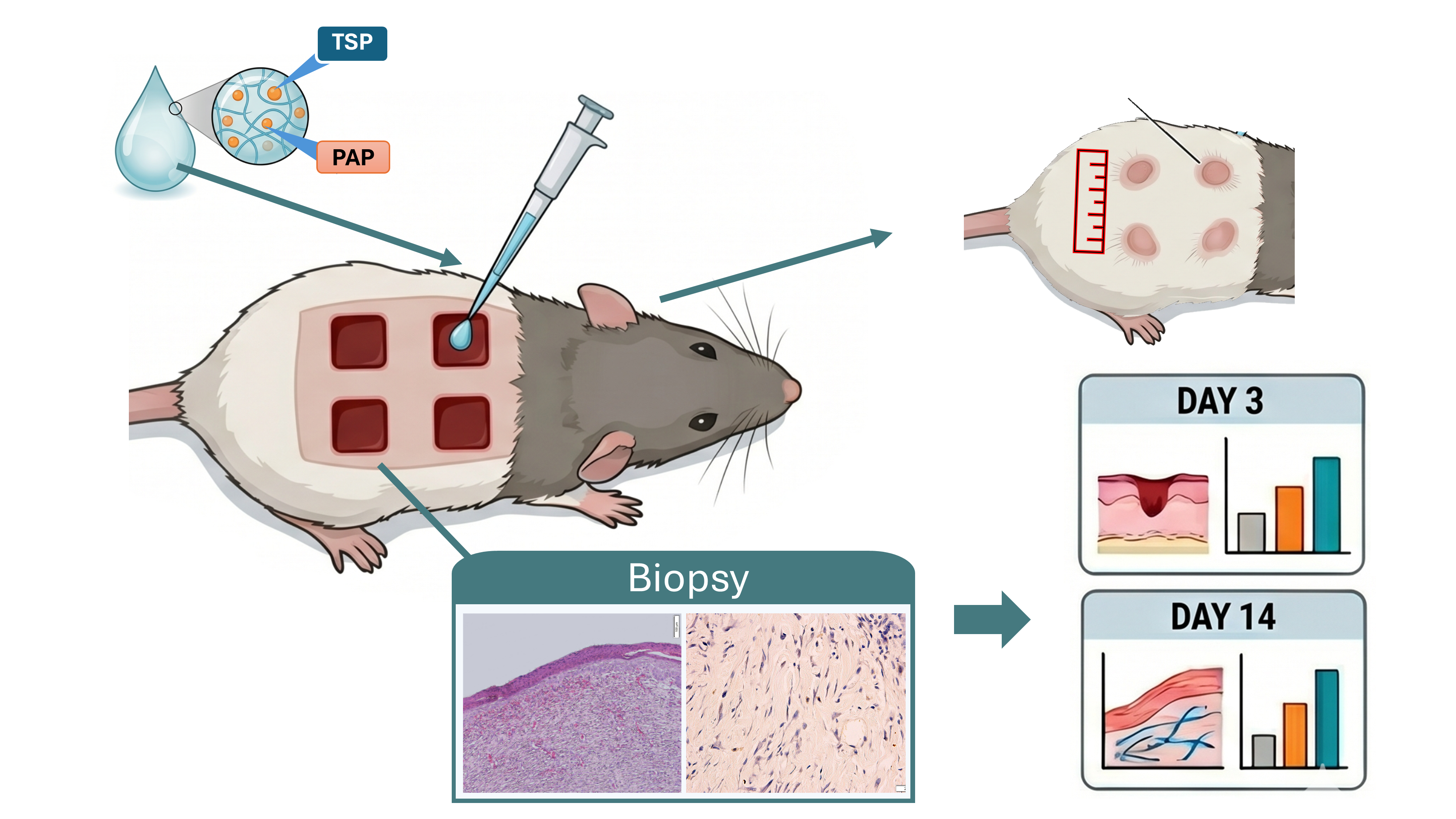
Wound healing is a complex process that can be impaired by various factors. Hydrogel is a recommended choice for keeping the skin moist and enhancing wound healing. Hydrogel can contain bioactive compounds to improve wound healing effectiveness further. Phagocytosis activating protein (PAP) and thrombospondin (TSP) can stimulate macrophage and promote cell proliferation. They had the potential to enhance wound healing when incorporated into a hydrogel. This study aims to evaluate the effect of PAP and TSP hydrogel on irritation and wound healing efficacy in a rat model. This experiment is conducted using a full-thickness wounds model in rats. The hydrogel formulations with PAP and/or TSP were applied to the wounds for 21 days. The wound contraction, histology, and TGF-β1 expression were measured. The results showed that low-dose PAP hydrogel had the best wound healing performance among all groups, with high TGF-β1 levels in the early phase and low levels in the late phase. Low-dose TSP hydrogel had similar but weaker effects than low-dose PAP hydrogel. There was no sign of skin irritation for all formulations. Hydrogel containing a low dose of PAP or TSP is a promising formula for further developing new wound dressing materials. It also opens an opportunity to cure some challenging to-treat wounds, such as diabetic and burn wounds.
References
Altuntas, S., H. K. Dhaliwal, A. Eid Radwan, M. Amiji, and F. Buyukserin (2022). Local Epidermal Growth Factor Delivery Using Nanopillared Chitosan–Gelatin Films for Melanogenesis and Wound Healing. Biomaterials Science, 11(1); 181–194
Aramwit, P. and A. Sangcakul (2007). The Effects of Sericin Cream on Wound Healing in Rats. Bioscience, Biotechnology, and Biochemistry, 71(10); 2473–2477
Bogadi, S., M. E. Uddin, M. H. Rahman, V. V. S. R. Karri, R. Begum, and S. E. Udeabor (2025). Wound Healing in the Modern Era: Emerging Research, Biomedical Advances, and Transformative Clinical Approaches. Journal of Drug Delivery Science and Technology, 110; 107058
Bonnici, L., S. Suleiman, P. Schembri-Wismayer, and A. Cassar (2024). Targeting Signalling Pathways in Chronic Wound Healing. International Journal of Molecular Sciences, 25(1); 50
Chen, H., F. Liang, C. Fu, Z. Wang, and Z. Zhang (2023). Valproic Acid Accelerates Skin Wound Healing in Mice Via Its Anti-Inflammatory and Apoptotic Cell Clearance-Promoting Effects. Journal of International Medical Research, 51(6); 03000605231184038
Chen, L.-s., B.-w. Zheng, C.-y. Zhao, C.-c. He, and X.-H. Gao (2026). The Role of Thrombospondin-1 in Dermatological Conditions. Frontiers in Medicine, 13; 1724955
DaCosta, M. L., M. C. Regan, M. Al Sader, M. Leader, and D. Bouchier-Hayes (1998). Diphenylhydantoin Sodium Promotes Early and Marked Angiogenesis and Results in Increased Collagen Deposition and Tensile Strength in Healing Wounds. Surgery, 123(3); 287–293
Deachamag, P., U. Intaraphad, A. Phongdara, and W. Chotigeat (2006). Expression of a Phagocytosis Activating Protein (PAP) Gene in Immunized Black Tiger Shrimp. Aquaculture, 255(1–4); 165–172
Franz, M. G. (2015). Wound Healing. In G. M. Doherty, editor, CURRENT Diagnosis & Treatment: Surgery. McGraw-Hill Education, New York, NY, 14 edition
Grellner, W., S. Vieler, and B. Madea (2005). Transforming Growth Factors (TGF-α and TGF-β1) in the Determination of Vitality and Wound Age: Immunohistochemical Study on Human Skin Wounds. Forensic Science International, 153(2); 174–180
Guo, S. and L. A. DiPietro (2010). Factors Affecting Wound Healing. Journal of Dental Research, 89(3); 219–229
He, X., W. Wu, Y. Hu, M. Wu, H. Li, L. Ding, S. Huang, and Y. Fan (2024). Visualizing the Global Trends of Peptides in Wound Healing through an In-Depth Bibliometric Analysis. International Wound Journal, 21(4); e14575
He, Y., J. Hu, A. Ma, P. Du, M. Yang, X. Xiong, and Y. Deng (2026). The Crosstalk Between Efferocytosis and Macrophage Polarization in Diabetic Wounds: A Comprehensive Review. Journal of Inflammation Research; 566523
Huang, L. and L. Fu (2015). Mechanisms of Resistance to EGFR Tyrosine Kinase Inhibitors. Acta Pharmaceutica Sinica B, 5(5); 390–401
Kamlungmak, S., J. Dechraksa, A. R. Padmavathi, S. Sawatdee, K. Tinpun, T. Nakpheng, and T. Srichana (2019). Lamellar Phase Behavior and Molecular Interaction of a Thermoresponsive Poloxamer and Crosslinked Poly(Vinyl Alcohol) Hydrogel. Materials Today Communications, 20; 100542
Berikut adalah daftar referensi yang telah dirapikan. Nama jurnal atau buku telah dicetak miring (italic) sesuai standar penulisan akademis, dan terdapat spasi di antara masing-masing entri agar Anda dapat langsung menyalinnya dengan mudah:
Daftar Referensi
Acciaretti, F., S. Vesentini, and L. Cipolla (2022). Fabrication Strategies Towards Hydrogels for Biomedical Application: Chemical and Mechanical Insights. Chemistry–An Asian Journal, 17(22); e202200797
Altuntas, S., H. K. Dhaliwal, A. Eid Radwan, M. Amiji, and F. Buyukserin (2022). Local Epidermal Growth Factor Delivery Using Nanopillared Chitosan–Gelatin Films for Melanogenesis and Wound Healing. Biomaterials Science, 11(1); 181–194
Aramwit, P. and A. Sangcakul (2007). The Effects of Sericin Cream on Wound Healing in Rats. Bioscience, Biotechnology, and Biochemistry, 71(10); 2473–2477
Bogadi, S., M. E. Uddin, M. H. Rahman, V. V. S. R. Karri, R. Begum, and S. E. Udeabor (2025). Wound Healing in the Modern Era: Emerging Research, Biomedical Advances, and Transformative Clinical Approaches. Journal of Drug Delivery Science and Technology, 110; 107058
Bonnici, L., S. Suleiman, P. Schembri-Wismayer, and A. Cassar (2024). Targeting Signalling Pathways in Chronic Wound Healing. International Journal of Molecular Sciences, 25(1); 50
Chen, H., F. Liang, C. Fu, Z. Wang, and Z. Zhang (2023). Valproic Acid Accelerates Skin Wound Healing in Mice Via Its Anti-Inflammatory and Apoptotic Cell Clearance-Promoting Effects. Journal of International Medical Research, 51(6); 03000605231184038
Chen, L.-s., B.-w. Zheng, C.-y. Zhao, C.-c. He, and X.-H. Gao (2026). The Role of Thrombospondin-1 in Dermatological Conditions. Frontiers in Medicine, 13; 1724955
DaCosta, M. L., M. C. Regan, M. Al Sader, M. Leader, and D. Bouchier-Hayes (1998). Diphenylhydantoin Sodium Promotes Early and Marked Angiogenesis and Results in Increased Collagen Deposition and Tensile Strength in Healing Wounds. Surgery, 123(3); 287–293
Deachamag, P., U. Intaraphad, A. Phongdara, and W. Chotigeat (2006). Expression of a Phagocytosis Activating Protein (PAP) Gene in Immunized Black Tiger Shrimp. Aquaculture, 255(1–4); 165–172
Franz, M. G. (2015). Wound Healing. In G. M. Doherty, editor, CURRENT Diagnosis & Treatment: Surgery. McGraw-Hill Education, New York, NY, 14 edition
Grellner, W., S. Vieler, and B. Madea (2005). Transforming Growth Factors (TGF-α and TGF-β1) in the Determination of Vitality and Wound Age: Immunohistochemical Study on Human Skin Wounds. Forensic Science International, 153(2); 174–180
Guo, S. and L. A. DiPietro (2010). Factors Affecting Wound Healing. Journal of Dental Research, 89(3); 219–229
He, X., W. Wu, Y. Hu, M. Wu, H. Li, L. Ding, S. Huang, and Y. Fan (2024). Visualizing the Global Trends of Peptides in Wound Healing through an In-Depth Bibliometric Analysis. International Wound Journal, 21(4); e14575
He, Y., J. Hu, A. Ma, P. Du, M. Yang, X. Xiong, and Y. Deng (2026). The Crosstalk Between Efferocytosis and Macrophage Polarization in Diabetic Wounds: A Comprehensive Review. Journal of Inflammation Research; 566523
Huang, L. and L. Fu (2015). Mechanisms of Resistance to EGFR Tyrosine Kinase Inhibitors. Acta Pharmaceutica Sinica B, 5(5); 390–401
Kamlungmak, S., J. Dechraksa, A. R. Padmavathi, S. Sawatdee, K. Tinpun, T. Nakpheng, and T. Srichana (2019). Lamellar Phase Behavior and Molecular Interaction of a Thermoresponsive Poloxamer and Crosslinked Poly(Vinyl Alcohol) Hydrogel. Materials Today Communications, 20; 100542
Kamlungmak, S., T. Nakpheng, S. Kaewpaiboon, M. A. K. M. Bintang, S. Prom-In, C. Chunhachaichana, and T. Srichana (2021). Safety and Biocompatibility of Mupirocin Nanoparticle-Loaded Hydrogel on Burn Wound in Rat Model. Biological and Pharmaceutical Bulletin, 44(11); 1707–1716
Khimmakthong, U., P. Deachamag, A. Phongdara, and W. Chotigeat (2011). Stimulating the Immune Response of Litopenaeus vannamei Using the Phagocytosis Activating Protein (PAP) Gene. Fish & Shellfish Immunology, 31(3); 415–422
Koh, T. J. and L. A. DiPietro (2011). Inflammation and Wound Healing: The Role of the Macrophage. Expert Reviews in Molecular Medicine, 13; e23
Kohyama, K., H. Kato, H. Okada, T. Ishihara, Y. Yasue, R. Kamidani, K. Suzuki, T. Miyake, H. Okuda, H. Shibata, et al. (2024). Concomitant Heparin Use Promotes Skin Graft Donor Site Healing by Basic Fibroblast Growth Factor: A Pilot Prospective Randomized Controlled Study. Contemporary Clinical Trials Communications, 42; 101375
Larouche, J., S. Sheoran, K. Maruyama, and M. M. Martino (2018). Immune Regulation of Skin Wound Healing: Mechanisms and Novel Therapeutic Targets. Advances in Wound Care, 7(7); 209–231
Liu, A., P. Garg, S. Yang, P. Gong, M. A. Pallero, D. S. Annis, J. E. Murphy-Ullrich, and S. E. Goldblum (2009). Epidermal Growth Factor-Like Repeats of Thrombospondins Activate Phospholipase Cγ and Increase Epithelial Cell Migration Through Indirect Epidermal Growth Factor Receptor Activation. Journal of Biological Chemistry, 284(10); 6389–6402
Liu, Z., L. Chen, B. Hao, Y. Hou, C. Lv, Y. Zhu, and C. Han (2025). SHP099-Containing Multi-Targeting Hydrogel Promotes Rapid Skin Reconstruction Through Modulating a Variety of Cells. Frontiers in Bioengineering and Biotechnology, 13; 1564827
Lowe, J. M., D. Menendez, and M. B. Fessler (2014). A New Inflammatory Role for p53 in Human Macrophages. Cell Cycle, 13(19); 2983–2984
Mârza, S. M., A. M. Dăescu, R. C. Purdoiu, M. Dragomir, M. Tătaru, I. Melega, and I. Papuc (2024). Healing of Skin Wounds in Rats Using Creams Based on Symphytum officinale Extract. International Journal of Molecular Sciences, 25(6); 3099
Miyazono, K. (2000). Positive and Negative Regulation of TGF-β Signaling. Journal of Cell Science, 113(7); 1101–1109
Muñoz-Torres, J. R., I. Garza-Veloz, P. Velasco-Elizondo, and M. L. Martinez-Fierro (2025). HEALS-A and GRADES: Novel Histological and Clinical Scales for Assessing Skin Regeneration in Murine Wound Healing Models. Diagnostics, 15(3); 387
Ozgok Kangal, M. K. and N. L. Kopitnik (2026). Physiology, Wound Healing. In StatPearls. StatPearls Publishing, Treasure Island, FL
Pakyari, M., A. Farrokhi, M. K. Maharlooei, and A. Ghahary (2013). Critical Role of Transforming Growth Factor Beta in Different Phases of Wound Healing. Advances in Wound Care, 2(5); 215–224
Pan, Y., Y. Li, X. Zhou, J. Luo, Q. Ding, R. Pan, and X. Tian (2025). Extracellular Matrix-Mimicking Hydrogel with Angiogenic and Immunomodulatory Properties Accelerates Healing of Diabetic Wounds by Promoting Autophagy. ACS Applied Materials & Interfaces, 17(3); 4608–4625
Sari, M. H. M., A. d. F. Cobre, R. Pontarolo, and L. M. Ferreira (2023). Status and Future Scope of Soft Nanoparticles-Based Hydrogel in Wound Healing. Pharmaceutics, 15(3); 874
Shekhar, M., M. DilliKumar, K. Vinaya Kumar, G. Gopakrishna, S. Rajesh, J. Kiruthika, and A. Ponniah (2012). Transcript Analysis of White Spot Syndrome Virus Latency and Phagocytosis Activating Protein Genes in Infected Shrimp (Penaeus monodon). Indian Journal of Virology, 23(3); 333–343
Siritientong, T., A. Angspatt, J. Ratanavaraporn, and P. Aramwit (2014). Clinical Potential of a Silk Sericin-Releasing Bioactive Wound Dressing for the Treatment of Split-Thickness Skin Graft Donor Sites. Pharmaceutical Research, 31(1); 104–116
Smith, J. and V. Rai (2024). Novel Factors Regulating Proliferation, Migration, and Differentiation of Fibroblasts, Keratinocytes, and Vascular Smooth Muscle Cells During Wound Healing. Biomedicines, 12(9); 1939
Sun, Y., H. Guo, Y. Bai, J. Chen, and Y. Li (2026). Roles of Efferocytosis in Wound Repair: Process, Cells, and Signals. Genes & Diseases, 13(3); 101937
Sweetwyne, M. T. and J. E. Murphy-Ullrich (2012). Thrombospondin-1 in Tissue Repair and Fibrosis: TGF-β-Dependent and Independent Mechanisms. Matrix Biology, 31(3); 178–186
Tao, L., S. Wu, Q. Wang, Z. Xi, Y. Zou, M. Cao, K. Liang, W. Xu, Q. Hu, Y. Ge, et al. (2025). IL-27 Accelerates Diabetic Wound Healing by Modulating Macrophage Polarization. International Immunopharmacology, 155; 114575
Terzian, T. and G. Lozano (2010). Building p53. Genes & Development, 24(20); 2229–2232
von Zastrow, M. and A. Sorkin (2021). Mechanisms for Regulating and Organizing Receptor Signaling by Endocytosis. Annual Review of Biochemistry, 90; 709–737
Widowati, W., D. Rahmat, A. Faried, I. M. Nainggolan, D. Priyandoko, T. L. Wargasetia, and J. Jeffrey (2025). Potential of Secretome Hydrogel for Wound Healing in LPS- and Scratch-Induced BJ Cells as an Inflammation Model. Science and Technology Indonesia, 10(4); 1242–1254
Wonglapsuwan, M., N. Khwanmuang, P. Deachamag, and W. Chotigeat (2020). Biological Activity of the Thrombospondin Epidermal Growth Factor Domain from Banana Shrimp (Fenneropenaeus merguiensis). ScienceAsia, 46S(1); 27–35
Wonglapsuwan, M., P. Kongmee, N. Suanyuk, and W. Chotigeat (2016). Roles of Phagocytosis Activating Protein (PAP) in Aeromonas hydrophila-Infected Cyprinus carpio. Developmental and Comparative Immunology, 59; 25–33
Xie, Y., Z. Wu, J. Wang, Z. Li, and Z. Hu (2025). Dissolvable Core–Shell Microneedle Patch for Biphasic Drug Delivery to Enhance Diabetic Wound Healing. ACS Applied Materials & Interfaces, 17(17); 25152–25162
Yu, H., B. Wang, Z. Li, K. Liu, W. Chen, S. Zhao, and L. Li (2025). Tβ4-Exosome-Loaded Hemostatic and Antibacterial Hydrogel to Improve Vascular Regeneration and Modulate Macrophage Polarization for Diabetic Wound Treatment. Materials Today Bio, 31; 101585
Zhang, P. and C. Liu (2020). Enhancement of Skin Wound Healing by rhEGF-Loaded Carboxymethyl Chitosan Nanoparticles. Polymers, 12(7); 1612
Zhang, Y., X. Liu, J. Zhao, J. Wang, Q. Song, and C. Zhao (2022). The Phagocytic Receptors of β-Glucan. International Journal of Biological Macromolecules, 205; 430–441
Zhao, Y., L. Huang, G. Lin, M. Tong, Y. Xie, H. Pan, and H. Xu (2022). Skin-Adaptive Film Dressing with Smart-Release of Growth Factors Accelerated Diabetic Wound Healing. International Journal of Biological Macromolecules, 222; 2729–2743
Zhao, Y., M. Li, J. Mao, Y. Su, X. Huang, W. Xia, and T. Zan (2024). Immunomodulation of Wound Healing Leading to Efferocytosis. Smart Medicine, 3(1); e20230036
Zheng, Y., Z. Ruan, S. Liu, X. Yang, and Z. Chen (2025). Exosome-Mediated Macrophage Polarization: Pioneering Pathways in Diabetic Wound Healing. International Immunopharmacology, 161; 115058
Authors

This work is licensed under a Creative Commons Attribution 4.0 International License.