
Spatial Data Science for Regional Pattern Analysis: Dynamic Time Warping-Based Clustering of East Java’s Economic Indicators
Article Sidebar
-
Dynamic Time Warping, Spatial Data Science, Spatial Temporal Clustering, Regional Development, East Java, Regional Economic Pattern
Abstract
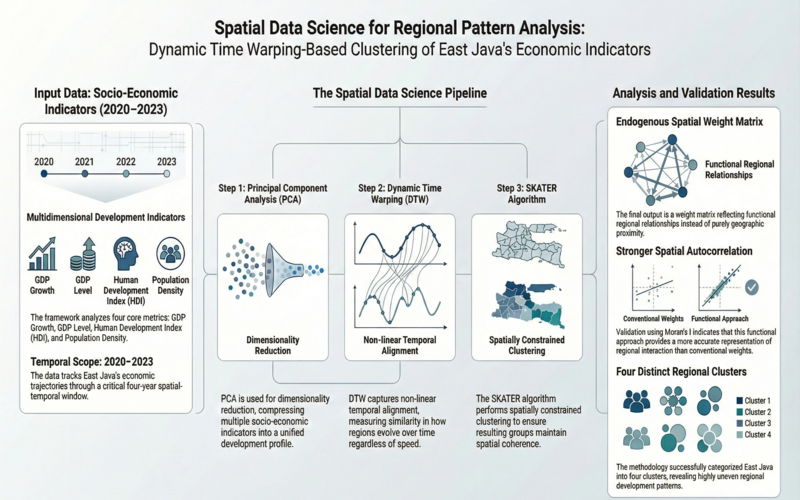
Motivated by the need to better capture dynamic regional disparities, this study examines spatial and temporal development patterns in East Java, Indonesia, using spatial panel data from 2020 to 2023. A data-driven framework is proposed that integrates Principal Component Analysis (PCA) for dimensionality reduction, Dynamic TimeWarping (DTW) for temporal similarity measurement, and spatially constrained clustering using the SKATER algorithm. PCA compresses multiple socio-economic indicators, GDP growth, GDP level, Human Development Index (HDI), and population density, into a unified development profile, enabling comparison of regional trajectories over time. DTW captures non-linear temporal alignment, while SKATER preserves spatial coherence in cluster formation. The resulting clusters are used to construct an endogenous spatial weight matrix that reflects functional regional relationships rather than purely geographic adjacency. Validation using Moran’s I indicates stronger spatial autocorrelation compared to conventional contiguity-based weights, suggesting improved representation of spatial interaction. Four clusters reveal distinct development patterns and uneven regional trajectories. By integrating dimensionality reduction with temporal alignment and spatial clustering, the proposed approach extends dynamic spatial weighting toward a functional interpretation of regional dependence and offers a transferable framework for spatial data science and regional policy analysis.
References
Assunção, R. M., M. C.Neves, G. Câmara, and C. da Costa Freitas (2006). Efficient Regionalization Techniques for Socio-Economic Geographical Units Using Minimum Spanning Trees. International Journal of Geographical Information Science, 20(7); 797–811
Atikah, N., S. Rahardjo, D. L. Afifah, and N. Kholifia (2021). Modelling Spatial Spillovers of Regional Economic Growth in East Java: An Empirical Analysis Based on Spatial Durbin Model. In Journal of Physics: Conference Series, volume 1872. IOP Publishing, page 012029
Beenstock, M. and D. Felsenstein (2019). The Econometric Analysis of Non-Stationary Spatial Panel Data. Springer
Eboy, O. V. and R. A. Kemarau (2023). Analysis of Extreme Heat Land Surface Temperature at a Tropical City (1988–2022): A Study on the Variability of Hot Spot During El Niño Southern Oscillation (ENSO). Science and Technology Indonesia, 8(3); 388–396
Elhorst, J. P. (2014). Spatial Econometrics: From Cross-Sectional Data to Spatial Panels. Springer
Fitriani, R. (2024). A Dynamic Spatial Cluster Based Spatial Weight Matrix to Detect Spatial Autocorrelation on Spatial Panel Data. In The International Symposium on Business and Industrial Statistics (ISBIS) 2024
Fitriani, R., Z. F. Pusdiktasari, and H. C. Diartho (2021). Growth Interdependence in the Presence of Spatial Outliers: Implementation of an Average Difference Algorithm on East Java Regional Economic Growth, 2011–2016. Regional Statistics, 11(3); 119–132
Geler, Z., V. Kurbalija, M. Ivanović, and M. Radovanović (2022). Elastic Distances for Time-Series Classification: Itakura Versus Sakoe-Chiba Constraints. Knowledge and Information Systems, 64(10); 2797–2832
Getis, A. and J. Aldstadt (2004). Constructing the Spatial Weights Matrix Using a Local Statistic. Geographical Analysis, 36(2); 90–104
Hardjoko, A. T., D. B. Santoso, A. Suman, and R. K. Sakti (2021). The Effect of Industrial Agglomeration on Economic Growth in East Java, Indonesia. The Journal of Asian Finance, Economics and Business, 8(10); 249–257
Khakim, M. Y. N., T. Tsuji, A. A. Bama, F. Virgo, M. Irfan, A. K. Affandi, and T. Matsuoka (2023). Monitoring the Muara Laboh Geothermal Field in Indonesia Using the ISBAS Method with Sentinel-1 SAR Images. Science and Technology Indonesia, 8(4); 626–631
Lee, L.-F. and J. Yu (2012). QML Estimation of Spatial Dynamic Panel Data Models with Time Varying Spatial Weights Matrices. Spatial Economic Analysis, 7(1); 31–74
Liu, J., B. Tian, and J. Wu (2023). Temporal Analysis of Infectious Diseases: A Case Study on COVID-19. Acadlore Transactions on Applied Mathematics and Statistics, 1; 1–9
Masías H, V. H., J. Stier, P. Navarro R, M. A. Valle, S. Laengle, A. A. Vargas, and F. A. Crespo R (2024). Evolving Demographics: A Dynamic Clustering Approach to Analyze Residential Segregation in Berlin. EPJ Data Science, 13(1); 1–41
Modak, S. (2024). Finding Groups in Data: An Introduction to Cluster Analysis: Authored by Leonard Kaufman and Peter J. Rousseeuw, John Wiley and Sons, 2005, ISBN: 0-471-73578-7. Taylor & Francis
Molné, F., G. F. A. Donati, J. Bolliger, M. Fischer, M. Maurer, and P. M. Bach (2023). Supporting the Planning of Urban Blue-Green Infrastructure for Biodiversity: A Multi-Scale Prioritisation Framework. Journal of Environmental Management, 342; 118069
Qu, X., L.-F. Lee, and C. Yang (2021). Estimation of a SAR Model with Endogenous Spatial Weights Constructed by Bilateral Variables. Journal of Econometrics, 221(1); 180–197
Quintero, Y., D. Ardila, J. Aguilar, and S. Cortes (2022). Analysis of the Socioeconomic Impact Due to COVID-19 Using a Deep Clustering Approach. Applied Soft Computing, 129; 109606
Shi,W. and L.-F. Lee (2018). A Spatial Panel DataModel with Time Varying EndogenousWeights Matrices and Common Factors. Regional Science and Urban Economics, 72; 6–34
Solihin, A.,W.W.Wardana, E. Fiddin, and N. M. Sukartini (2021). Do Government Policies Drive Economic Growth Convergence? Evidence from East Java, Indonesia. Cogent Economics & Finance, 9(1); 1992875
Tarekegn, A. N., B. Tessem, and F. Rabbi (2025). A New Cluster Validation Index Based on Stability Analysis. In Proceedings of the International Conference on Pattern Recognition Applications and Methods (ICPRAM). pages 377–384
Wiafe, S.-L., S. Kinsey, A. Iraji, R. Miller, and V. D. Calhoun (2025). Normalized Dynamic TimeWarping Increases Sensitivity in Differentiating Functional Network Connectivity in Schizophrenia. In 2025 47th Annual International Conference of the IEEE Engineering in Medicine and Biology Society (EMBC). IEEE, pages 1–4
Yang, A., L. Zhang, S. Zhang, Z. Zhan, and J. Shi (2022). Research on the Temporal and Spatial Characteristics, Spatial Clustering and Governance Strategies of Carbon Emissions in Cities of Shandong. Frontiers in Environmental Science, 10; 1024122
Zhang, H., Y. Dong, J. Li, and D. Xu (2021). Dynamic Time Warping Under Product Quantization, with Applications to Time-Series Data Similarity Search. IEEE Internet of Things Journal, 9(14); 11814–11826
Zhang, J., C. Zhao, and X. Qu (2025). Nonlinear Spatial Dynamic Panel Data Models with Endogenous Dominant Units: An Application to Share Data. Journal of Business & Economic Statistics, 43(1); 150–163
Zheng, T., Y. Luo, X. Zhou, L. Zhang, and Z. Teng (2023). Spatial Dynamic Analysis for COVID-19 Epidemic Model with Diffusion and Beddington-DeAngelis Type Incidence. Communications on Pure and Applied Analysis, 22(2); 365–396
Authors

This work is licensed under a Creative Commons Attribution 4.0 International License.